 StreamLive Pro
How to produce a live news show online
How a small newsroom produces a live news show online: a rundown, an anchor and remote correspondents, a ticker and names, breaking news from a phone, and clips after.
A news show is the most demanding kind of live stream for its size. It runs to the minute, it mixes a studio with people in other places, it puts names and facts on screen that must be right, and when something happens it has to go live in minutes, not hours. A small newsroom can do it from a browser, as long as the show is built on a rundown and the roles are clear.
This guide covers a regular show (daily or weekly, 15 to 60 minutes) and the breaking-news live, and where StreamLive Pro fits in each.
The rundown comes first
Every item in the show gets a line: what it is, who is on screen, what graphics it needs, and how long it runs.
| Time | Item | On screen | Graphics |
|---|---|---|---|
| 00:00 | Opening and headlines | Anchor | Show logo, ticker on |
| 01:30 | Lead story | Anchor, then correspondent from the scene | Correspondent's name and place |
| 06:00 | Interview | Anchor and a remote guest side by side | Guest's name and role |
| 14:00 | Short items | Anchor with a photo or a screen | Lower third per item |
| 18:00 | Close and what is next | Anchor | Next show's time |
The person at the switcher follows the rundown, not the anchor's memory. Print it or keep it open next to the studio.
Roles, even in a team of three
- Anchor. Reads, interviews, keeps time.
- Director. Switches cameras and guests, puts graphics on and off, watches the sound.
- Producer. Talks to the guests and correspondents before they go on, checks names and facts in the graphics, watches the chat.
With two people, the director also produces. With one, keep the show simple: one camera, one guest at most, graphics prepared in advance.
The studio in the browser
- Cameras. The anchor's camera, plus a phone as a second angle or as a camera for a correspondent who is in the building (Use your phone as an extra camera). Each source is set in Preview and sent to air with Take (Preview, Program, Take and Cut explained).
- Correspondents and guests. They join from a link in their browser, from home or the scene, and wait until the producer has checked their sound and picture. One link serves everybody and is valid for 4 hours; create a fresh one for a later show (How to do a live interview with a remote guest).
- Names. A lower third for every person, prepared before the show, with the exact spelling the producer checked (How to make lower thirds for a live stream).
- Ticker. The crawl at the bottom with headlines, in Hebrew right to left or in English left to right, with speed and colours set in advance (Add a news ticker to your live stream).
- Logo. The show's logo on an overlay channel that stays on top while you switch (Add a logo and overlays to your live stream).
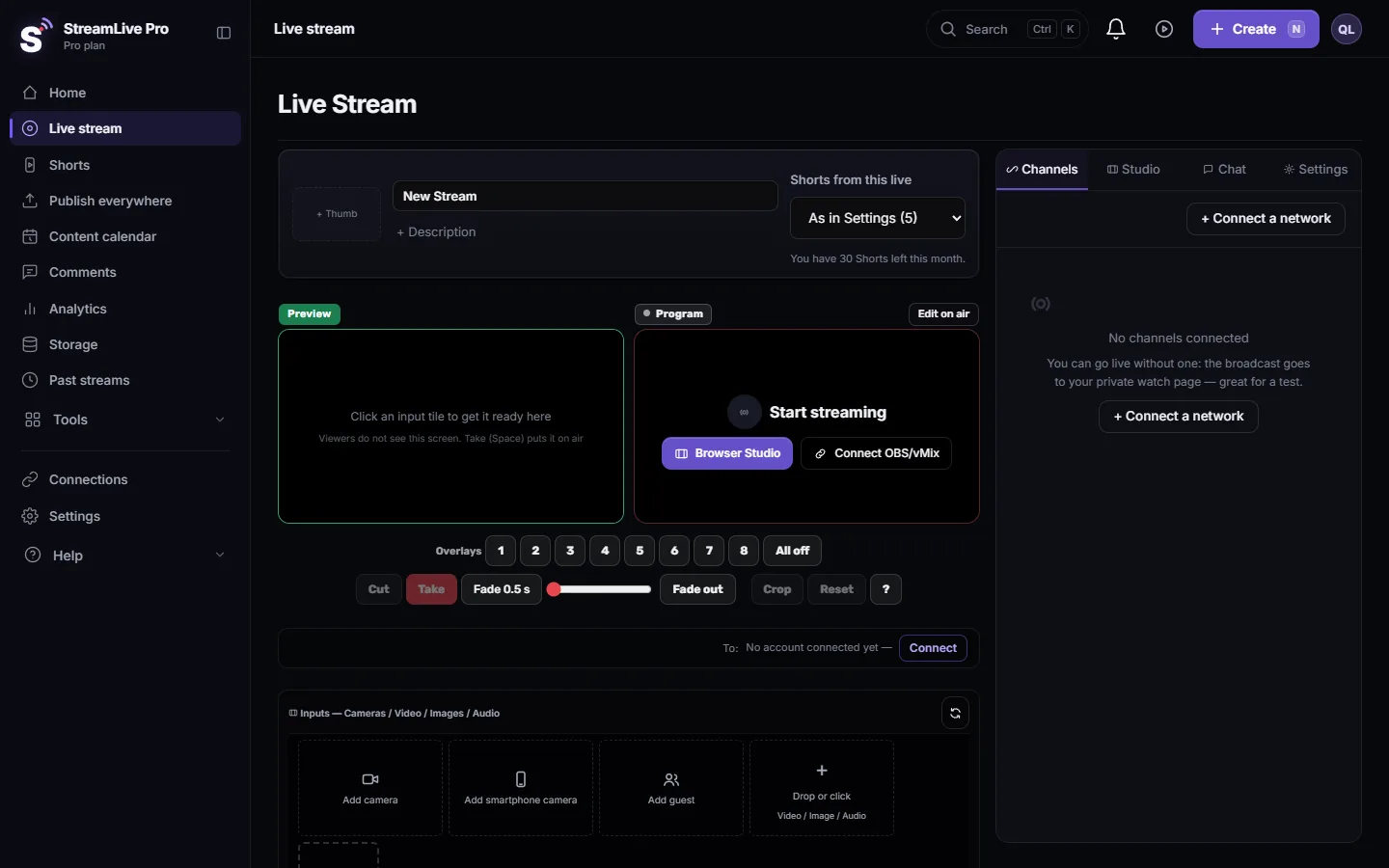
A newsroom that already has a hardware switcher or vMix can keep it and send the program to StreamLive Pro by RTMP, RTMPS or SRT, which then sends it to every network. Encoder input is on the paid plans.
Where to broadcast
News audiences are spread out: YouTube, a Facebook Page, X, Telegram and others. StreamLive Pro sends one stream from the studio to all of them at once, and the number of networks at once depends on the plan (/pricing?lang=en). X and Telegram connect with a stream key; for X the key changes between sessions, so paste a fresh one before each live (How to multistream to X (Twitter) and other networks at the same time, How to live stream to a Telegram channel or group).
Comments from YouTube and Facebook appear in one panel on the live page, and you can reply to both. Other networks' comments stay on those networks.
Breaking news
When something happens, the regular setup is too slow. Keep a breaking-news routine:
- A reporter at the scene goes live from the phone browser, or joins the studio as a guest from the phone so the anchor can talk to them (Go live from your phone).
- The networks are already connected and a breaking-news title template is ready, so going live takes a minute.
- The anchor joins from home by the guest link if the studio is closed.
- Facts on screen only after a check. A wrong name in a lower third travels further than the correction.
After the show
- Press Record during the show if you want the full video kept; otherwise it is removed about two hours after the end (Where is my live stream recording?).
- Shorts. Up to 5 vertical Shorts are cut from the show automatically, with captions and a crop that follows the speaker. There is a News / Commentary visual style for them in the automatic Shorts settings. Read every caption before publishing: names and places in the news are exactly where transcription errs (Edit a Short before you publish it).
- Publish the clips. To YouTube Shorts, Reels, TikTok and the other networks, from the Shorts page. TikTok posts are made by hand, never scheduled (Post a Short to YouTube Shorts, Reels and TikTok).
- WhatsApp and Telegram. A newsroom that runs WhatsApp or Telegram groups can publish from them to the networks with Post from groups, on Pro and Studio and in the trial (Post to every network from a WhatsApp or Telegram group).
- Other languages. Translate the captions of a clip for a second audience (Translate the captions of a Short).
Common mistakes
- No rundown. The director guesses, and the show drifts.
- Graphics typed during the show. Prepare names and the ticker text before going live.
- A guest sent on air without a sound check. The producer checks every guest first.
- Facts on screen before they are confirmed. Corrections do not catch up.
- No Record. The full show is gone about two hours later.
Where StreamLive Pro fits
StreamLive Pro gives a small newsroom a studio in the browser with cameras, remote correspondents by link, names, a right-to-left ticker and a logo, sends one stream to every network at once, and turns the show into captioned clips afterwards. It does not replace a newsroom system for writing scripts, and captions and translation are not shown live during the broadcast. More for newsrooms: /for/news?lang=en.
Frequently asked questions
What do I need to produce a live news show online?
A computer with a stable connection, a camera and microphone for the anchor, a browser studio that takes remote guests by link, prepared graphics for names and headlines, and a rundown everyone follows.
Can correspondents join from the field?
Yes. They open a link in the phone or computer browser and join as guests, without installing anything. The producer checks their sound before they go on air.
Can the ticker run in Hebrew?
Yes. The ticker can run right to left for Hebrew or left to right for English, with its own speed, size and colours.
Can I stream a news show to YouTube, Facebook and Telegram at once?
Yes. Connect each network once and tick them for the live. How many networks you can use at the same time depends on the plan.
Can viewers get live captions during the news?
No. Live captions are not available during a broadcast. Captions and translations are made for the recording and the clips after the show.
Keep reading
Run a live Q&A: collect questions before, read YouTube and Facebook chat in one panel, show a question on screen, bring in an expert by link, and reuse the answers.
How to live stream a panel discussionHow to live stream a panel discussion with remote speakers: invites, layouts for three to five people, a moderator's run sheet, audience questions on screen, and Shorts.
How to live stream a Torah class: setup and soundLive stream a Torah class: three setups by budget, why sound beats picture, camera placement, audience privacy and a simple weekly routine.
How to live stream a conferenceHow to live stream a conference: the room sound, cameras and slides, one live per session or one long day, remote speakers, recording, and Shorts after it.
Want to try it? 7-day trial, no credit card.
Start free