 StreamLive Pro
How to live stream a conference
How to live stream a conference: the room sound, cameras and slides, one live per session or one long day, remote speakers, recording, and Shorts after it.
A conference stream fails in predictable places: the sound is taken from a camera microphone at the back of the hall, the slides are unreadable, a remote speaker cannot be heard in the room, and at five in the afternoon nobody remembers whether the morning was recorded. None of this needs expensive gear. It needs decisions made before the doors open, a crew member who owns each one, and a test in the real room.
This guide walks through those decisions for a one-day or two-day event with several speakers, and shows where StreamLive Pro fits: one stream from the venue, sent to YouTube, a Facebook Page and other networks at once, with Shorts cut from each session afterwards.
First decision: one long live, or one live per session
| Feature | One live for the whole day | One live per session |
|---|---|---|
| For viewers | One link, but a replay of eight hours | A clear title and replay for each talk |
| For the crew | Start once; breaks need a holding screen | Start and stop around every session |
| Shorts after it | Up to 5 from the whole day | Up to 5 from every session |
| Recording | One very large file | One file per talk, easy to share with the speaker |
| Risk | One mistake affects the whole day | A failed start affects one talk |
For most conferences, one live per session is the better trade. Each speaker gets a replay with their own title, and each talk can give its own Shorts. Schedule the sessions ahead with Schedule broadcast: each gets its title, description and networks, and for YouTube and Facebook you can pre-announce the event so people can find it before it starts. See Schedule a live broadcast in advance. Mind the plan limits: the number of networks at once and the streaming hours per month depend on the plan, on the /pricing?lang=en.
Sound: take it from the venue's mixer
Viewers forgive a soft picture; they leave over bad sound. The room microphones already go into the venue's sound desk, so take a feed from there:
- Ask the venue's sound technician for a line out of the main mix, or an auxiliary mix without the room's music.
- Bring it into the computer through a USB audio interface, or through a USB capture card together with the camera.
- Keep a camera microphone as a backup source in the studio, muted.
- Listen on headphones on the streaming computer, not on the speakers in the hall.
Remote speakers need the opposite path too: the hall has to hear them. Send the streaming computer's output back to the sound desk, and make sure the remote speaker does not hear themselves back; the studio's mix-minus handles that for guests.
Cameras and slides
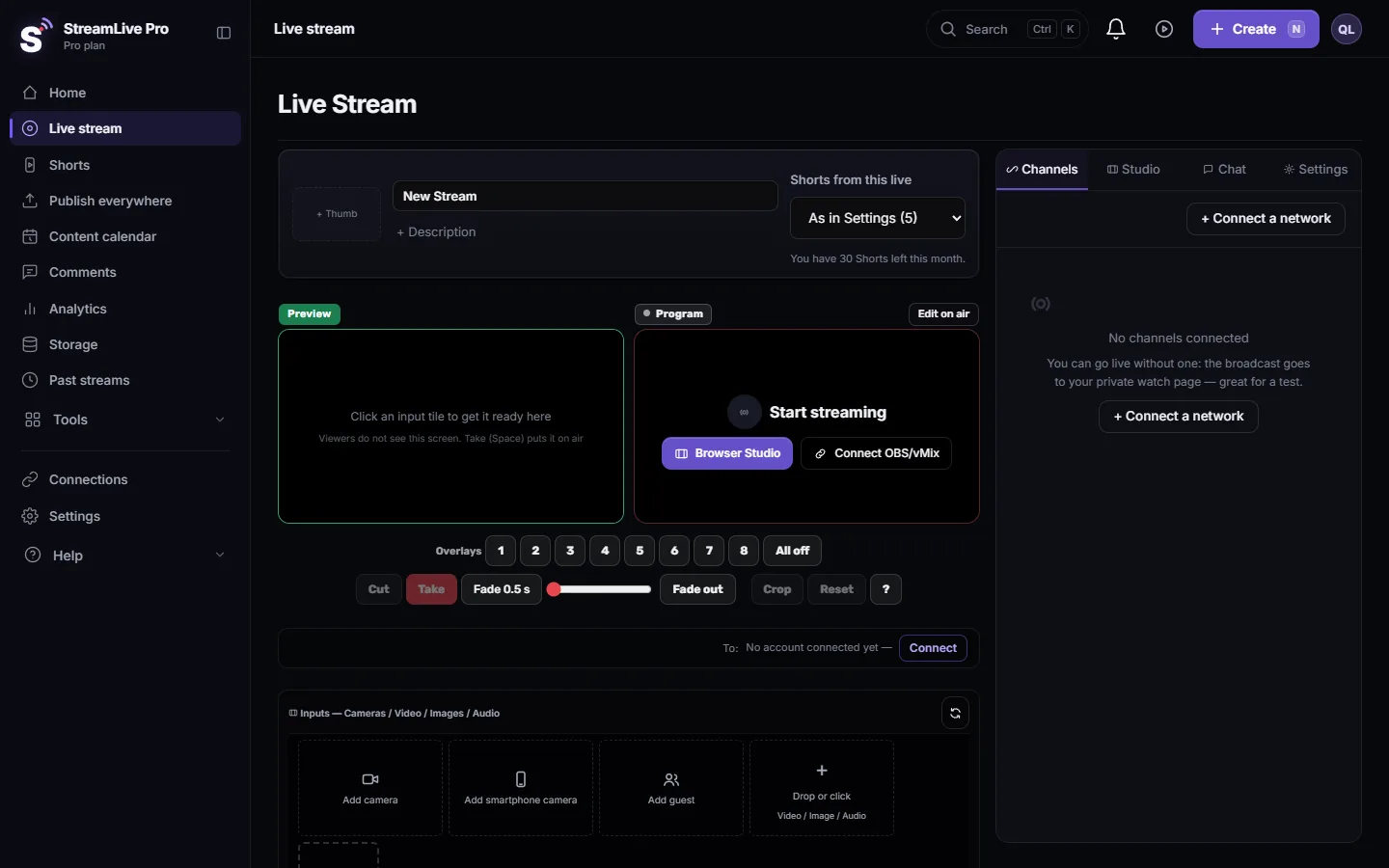
A two-camera setup covers most rooms: a wide shot of the stage that never moves, and a tighter shot of the speaker at the lectern. Add a phone as a third camera for the audience or a panel, by link or QR code (Use your phone as an extra camera).
For the slides, take the presenter's laptop output through a second capture card, or share the screen of a laptop that runs the studio (How to share your screen in a live stream). A slide filmed by a camera is rarely readable on a phone.
In the browser studio, each source is set in Preview and sent to air with Take. Put the speaker's name on air with a lower third at the start of each talk, and the event logo on an overlay channel that stays on top. See How to live stream with several cameras and How to make lower thirds for a live stream.
A larger production with a hardware switcher, vMix or OBS can send its program to StreamLive Pro instead, by RTMP, RTMPS or SRT, and StreamLive Pro sends it on to every network. Encoder input is on the paid plans; the 7-day trial uses the browser studio. See Streaming from OBS or vMix with RTMP.
Remote speakers
A speaker who cannot travel joins by a link in the browser, with no installation. One link works for everybody and is valid for 4 hours, so for a full day create a new link before the afternoon sessions. Before their slot, check their sound in the waiting area, then place them on screen. How many guests can join at once depends on the plan. See How to do a live interview with a remote guest and Guests and invitations — bringing people into the room.
The venue's internet
Ask for a wired connection for the streaming computer, not the guest Wi-Fi the whole audience will use. You send one stream from the venue whatever the number of networks, because StreamLive Pro sends the copies from its servers. Measure the upload in the hall on the day you test, and pick a bitrate with room to spare: Upload speed and bitrate for multistreaming.
Recording: press Record
A broadcast is kept only if you press Record during it, or keep it afterwards from its menu in Past streams. Otherwise the video is removed about two hours after the end. At a conference this matters: speakers will ask for their talk. Make pressing Record part of the start of every session, on a checklist. See Where is my live stream recording?.
After the event: Shorts from every talk
When each session ends, up to 5 vertical Shorts are cut from it automatically, with captions and a crop that follows the speaker. Watch them, fix names in the captions, and publish them over the following days with the Publish all bar, one a day by default. Shorts count toward the plan's monthly number, so for a two-day event with many sessions, set how many you want per live in advance (How many Shorts can I make?).
A run sheet for the day
- The day before: test in the hall with the venue's sound, the capture cards, a test broadcast to a network nobody watches yet, and the real internet line.
- One hour before doors: start the computer, run the 10-second camera check (The 10-second camera check before you go live), check the scheduled lives.
- Before each session: speaker's lower third ready, slides source in Preview, remote speaker in the waiting area.
- Start: go live, press Record, check one network on a phone.
- During: watch the chat from YouTube and Facebook in one panel (Live chat from YouTube and Facebook in one panel) and pass questions to the moderator.
- End: stop the live, confirm the recording is kept, move to the next session.
Common mistakes
- Sound from the camera microphone. Take the venue's mix.
- One person doing everything. Separate the person who switches cameras from the person who watches sound and chat.
- The guest Wi-Fi. Use a wired line, tested in the hall.
- No Record. Without it, the talk is gone about two hours later.
- A guest link created in the morning for an evening speaker. It expires after 4 hours.
Where StreamLive Pro fits
StreamLive Pro sends one stream from the venue to YouTube, a Facebook Page, LinkedIn, X, Twitch, Kick and any RTMP or SRT server at once, from a browser studio or from your own encoder, and turns each session into Shorts afterwards. It does not replace the venue's sound desk or cameras, and it does not sell tickets or manage registration. Captions and translation are made for the recordings and Shorts after the event, not live during it. Plans and limits: /pricing?lang=en.
Frequently asked questions
What do I need to live stream a conference?
A computer with a wired connection, a sound feed from the venue's mixer, one or two cameras through capture cards, the presenter's slides as a separate source, and a streaming service that sends the stream to your networks.
Should a conference be one live stream or several?
One per session usually works better. Each talk gets its own title and replay, and Shorts are cut from each session separately.
Can remote speakers present at a live conference?
Yes. They join through a browser link with no installation. Their sound must also be sent to the hall's sound system so the audience in the room hears them.
Is the conference recorded automatically?
Only if you press Record or keep the broadcast afterwards. Otherwise the video is removed about two hours after each session ends.
Can viewers see live captions?
No. Live captions are not available during the broadcast. Captions and translations are made for the recordings and Shorts after the event.
Keep reading
How to live stream a panel discussion with remote speakers: invites, layouts for three to five people, a moderator's run sheet, audience questions on screen, and Shorts.
Switcher Studio alternative: Switcher vs StreamLive ProSwitcher Studio alternative for multicamera live streams with phones: devices, destinations, guests, hosting and Shorts, from Switcher's pages checked November 2026.
How to host a live Q&A session on YouTube and FacebookRun a live Q&A: collect questions before, read YouTube and Facebook chat in one panel, show a question on screen, bring in an expert by link, and reuse the answers.
How to live stream a cooking show with two camerasHow to live stream a cooking show with two cameras: a phone overhead on the pan, the cook's face, picture in picture, sound in a noisy kitchen, and Shorts of each recipe.
Want to try it? 7-day trial, no credit card.
Start free