 StreamLive Pro
What is OAuth? Connecting an account without a password
What OAuth is: how one app gets limited access to your account on another service without your password. Tokens, scopes, why connections expire, how to revoke.
OAuth is the standard way to let one app act on your account at another service without giving it your password. When you connect YouTube to StreamLive Pro, you are sent to Google's own sign-in page, you sign in there, and Google shows what StreamLive Pro is asking to do. If you approve, Google gives StreamLive Pro a token: a key that works only for what you approved, only for your account, and only until it expires or you take it back. Your Google password never reaches us.
The OAuth 2.0 standard opens with exactly this idea: it "enables a third-party application to obtain limited access to an HTTP service" (IETF RFC 6749: The OAuth 2.0 Authorization Framework, checked 5 November 2026).
The parts, in plain words
| Term | What it means | Example |
|---|---|---|
| Account owner | You | The owner of the YouTube channel |
| Client | The app that wants access | StreamLive Pro |
| Authorization server | The service's sign-in and approval page | Google's sign-in page |
| Scope | One permission that is asked for | Manage your YouTube broadcasts |
| Consent screen | The page that lists the scopes and asks you to approve | "StreamLive Pro wants to..." |
| Access token | The limited key the client receives | Used for each request to YouTube |
| Refresh token | A key that gets a new access token when the old one expires | Lets a connection last for weeks |
| Revoke | Taking the access back | Removing the app in your Google account settings |
What happens when you click Connect
Take YouTube as the example, though every OAuth network follows the same pattern:
- You click the YouTube card in Connections. StreamLive Pro sends your browser to Google, with a note of which permissions it asks for.
- Google asks you to sign in, if you are not signed in already, and to pick the account and channel.
- Google shows the consent screen with the permissions in plain words. You approve, or cancel.
- Google sends your browser back to StreamLive Pro with a one-time code.
- StreamLive Pro exchanges that code with Google, directly and out of sight, for the access token and a refresh token.
- The card turns connected. From then on, StreamLive Pro uses the token for each request, and quietly refreshes it when it runs out.
If you cancel at step 3, nothing is connected and nothing is stored.
OAuth or a password or a key
| Way to connect | Does the app see your password | Can you limit what it does | How you stop it |
|---|---|---|---|
| OAuth sign-in | No | Yes, by scopes | Revoke in the service's settings, or Disconnect in the app |
| Your password typed into the app | Yes | No, it can do everything you can | Change your password |
| A stream key | No password, but the key alone lets anyone broadcast to that channel | Only streaming, nothing else | Reset the key at the network |
| An app password (some services, such as Bluesky) | Not your main password | Depends on the service | Delete the app password |
That is why serious services offer OAuth: a leaked token can do less, for less time, and you can cancel it without changing your password.
Where you meet OAuth in StreamLive Pro
Connecting your networks. In Connections most networks connect with the network's own sign-in: YouTube, Facebook (a Page you manage), Twitch and Kick for going live, and YouTube, Facebook, Instagram, TikTok, X, LinkedIn, Threads and others for posting. You choose the account or Page on the network's own screen. Networks that connect another way: Instagram and TikTok LIVE, LinkedIn Live and custom servers use a stream key; Discord and Slack use a webhook; Bluesky uses an app password. See Connecting your networks: the complete guide.
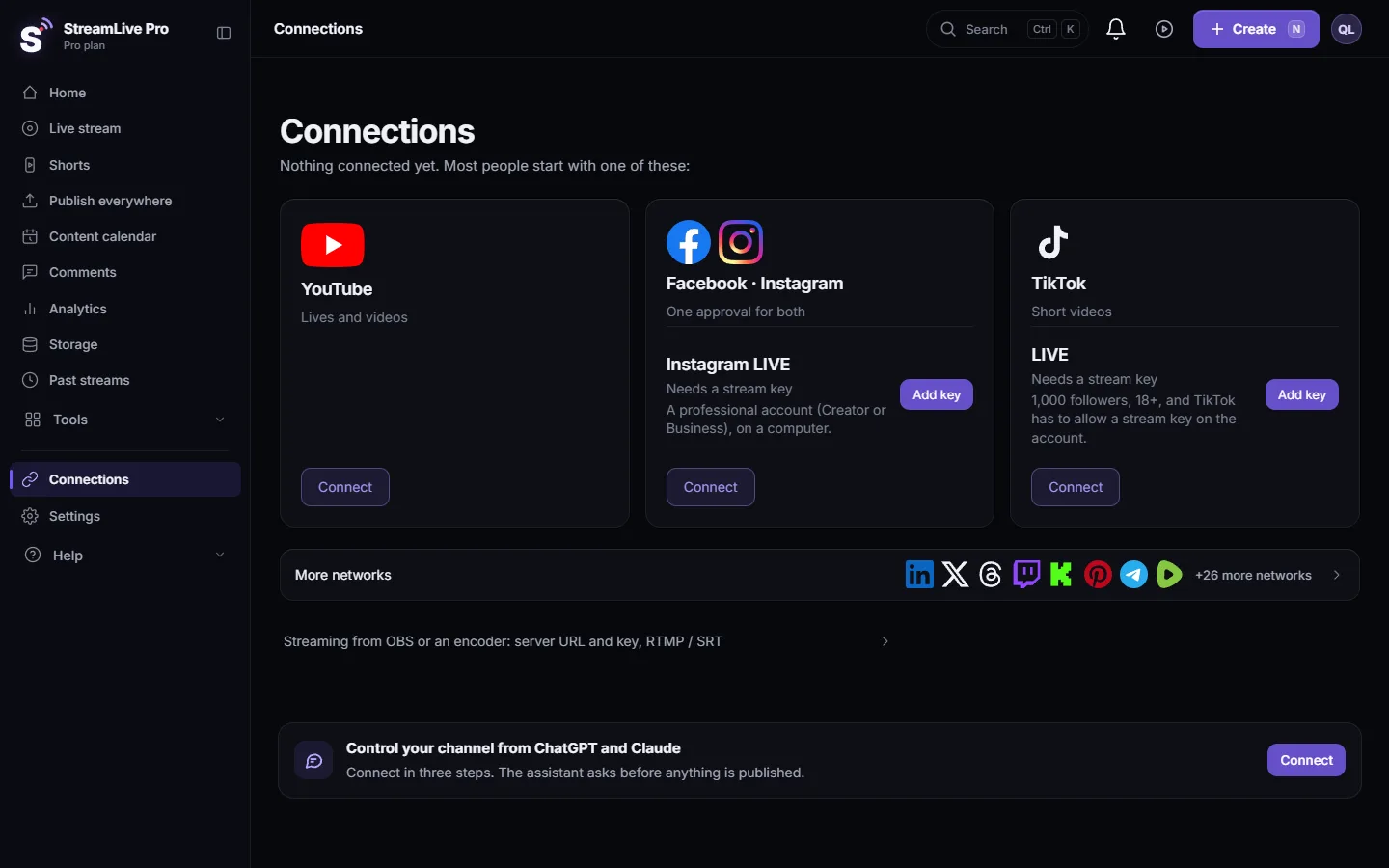
Connecting ChatGPT or Claude to StreamLive Pro. Here StreamLive Pro is the service that signs you in. When you add StreamLive Pro as a connector, ChatGPT or Claude sends you to our sign-in page, and you approve what the assistant may do: read your account and broadcasts, manage lives, work with Shorts and posts, read analytics and comments. Access to stream keys is a separate, sensitive permission that is asked for only when needed. The assistant asks you before it publishes or ends anything. See What is MCP (Model Context Protocol)? A plain explanation.
Why connections expire
A token does not last forever. A connection stops working when:
- you changed the password of that account, which often cancels existing tokens
- you removed StreamLive Pro in the network's security settings
- the network's own time limit for the token passed and it could not be refreshed
- the permissions you approved changed, for example a Page role was removed
The channel then shows a reconnect message, and lives and posts to it stop until you sign in again. Reconnecting is one click and a fresh sign-in: Reconnect a channel whose connection expired. Reconnect notifications are sent once per connection until it is fixed.
How to take access back
- From StreamLive Pro: Disconnect the channel in Connections.
- From the network: every major network lists connected apps in its security or privacy settings; removing StreamLive Pro there cancels the token on their side.
- ChatGPT or Claude: in StreamLive Pro open Settings, Security, Connected apps and API, and disconnect. See Disconnect ChatGPT or Claude from StreamLive Pro.
Safe habits
- Check the address bar before you sign in. It should be the network's own domain, not a look-alike.
- Read the consent screen. If an app asks for far more than it needs, stop.
- Approve the right account. On Facebook choose the Page you want to stream to; on YouTube the right channel.
- Review connected apps once in a while and remove the ones you no longer use.
- Never type a network password into another site. OAuth exists so you do not have to.
Frequently asked questions
What is OAuth in simple terms?
A way to let one app use part of your account at another service, by signing in on that service's own page and approving specific permissions. The app gets a limited token, never your password.
Does StreamLive Pro see my YouTube or Facebook password?
No. You sign in on Google's or Facebook's own page. StreamLive Pro receives only a token for the permissions you approved.
Why do I have to reconnect a channel sometimes?
The token stopped working: you changed the password, removed the app at the network, or the network's time limit passed. Reconnect with a new sign-in.
Is a stream key the same as OAuth?
No. A stream key only lets someone send video to one channel, and anyone who has it can use it. OAuth gives a named app limited permissions that you can revoke.
Keep reading
Schedule live streams and posts on YouTube, Facebook and more: lives, posts, Shorts, groups and AI, the Content calendar, what runs by itself, and the limits.
My post failed on one networkA post went out on some networks and failed on one. How to read the reason, fix the usual causes, and send it again only to the network that failed.
Delete a published post from every networkRemove a post you published from YouTube, Facebook, LinkedIn and X in one step with Delete everywhere, and what to do on Instagram, TikTok and the others.
Short or regular video: how each network gets your videoHow StreamLive Pro decides if your video goes out as a YouTube Short, a Reel or a regular video: shape and length per network, and how to get the other one.
Want to try it? 7-day trial, no credit card.
Start free