 StreamLive Pro
What is MCP (Model Context Protocol)? A plain explanation
What MCP, the Model Context Protocol, means in plain words: servers, tools, OAuth and scopes, and how ChatGPT and Claude use it to work with StreamLive Pro.
MCP, the Model Context Protocol, is an open standard for connecting AI assistants to other software. Its own documentation describes it as "an open-source standard for connecting AI applications to external systems" and compares it to a USB-C port: one standard plug instead of a different cable for every device (Model Context Protocol: introduction). In practice, when an app offers an MCP server, an assistant such as ChatGPT or Claude can read from it and act in it, inside the limits you approve.
Below are the words you meet when you connect an assistant, and what each one means in StreamLive Pro.
The short version
- An MCP server is the app's side. It lists what an assistant may do there.
- An MCP client is the assistant's side: ChatGPT, Claude, or a code editor that speaks MCP.
- A tool is one action the server offers, such as "list my lives" or "schedule a live".
- You connect once, sign in to the app, and approve permissions. From then on you ask in plain words, and the assistant picks the tool.
Nothing about MCP gives the assistant your password. You sign in on the app's own page, and the app gives the assistant a token limited to what you approved.
Terms you will see
| Term | What it means | In StreamLive Pro |
|---|---|---|
| Model Context Protocol (MCP) | The open standard that assistants and apps use to talk | The way ChatGPT and Claude reach your account |
| MCP server | The app's endpoint that offers tools | https://streamlivepro.io/mcp |
| MCP client / host | The assistant or program that connects to servers | ChatGPT, Claude |
| Tool | One action with defined inputs and outputs | 24 public tools, from get_go_live_readiness to publish_clip |
| Connector / app | What the assistant calls a connected MCP server | Claude: custom connector. ChatGPT: an app made in developer mode |
| OAuth | Signing in on the app's own page and approving access, without sharing the password | You sign in to StreamLive Pro and approve |
| Scope / permission | One area of access you approve | For example read lives, change lives, make Shorts, publish, read analytics |
| Confirmation | A step where the assistant must ask you before acting | Ending a live, cancelling, and publishing a Short wait for your yes |
| API key | A secret for your own code, not for an assistant | The REST API, on the Studio plan only |
How a request travels
For example, you type in Claude: "What do I still need to go live tonight on YouTube and Facebook?"
- The assistant reads your request and sees that the StreamLive Pro connector has a tool for it.
- It calls the tool get_go_live_readiness on our MCP server, with the token from your sign-in.
- The server checks the token and the scope. If you did not approve reading lives, the call is refused.
- The server runs the same checks as the website. Your plan limits apply exactly as they do in the dashboard.
- The answer comes back as data: which channels are ready, what is missing, in what order.
- The assistant writes it in plain words, and suggests the next step.
Nothing in this chain lets the assistant do more than the website lets you do.
What MCP is not
- Not a model. MCP does not make an assistant smarter. It gives it a standard way to reach data and actions.
- Not a blank cheque. The server decides which tools exist, and you decide which permissions to approve. A tool that is not offered cannot be called.
- Not the same as an API key. An API key is for code you write. An MCP connection is for an assistant, approved through sign-in and limited by scopes.
- Not a replacement for the app. Some things stay in the app on purpose: connecting a network, payments, passwords, and in StreamLive Pro also TikTok, Pinterest and WhatsApp posts.
MCP in StreamLive Pro
StreamLive Pro runs a public MCP server. Connecting an assistant is included in every plan and the 7-day trial, at no extra charge.
- Reading tools answer questions: your plan and usage, connected channels and whether they are healthy, lives and their status, live chat from YouTube, Facebook, Twitch and Kick, Shorts, posts, results over 7, 28, 90 or 365 days against the previous period, your podcast feed status, and this help center.
- Tools that change something create or schedule a live, change its title or time, cut Shorts from an ended live, update a scheduled post, and move a PTZ camera through the desktop app (which is not released yet, so the camera tools find nothing today).
- Tools that wait for you: ending a live, cancelling a scheduled live or post, and publishing a Short. Publishing first returns a preview, and goes out only after you approve it in the chat.
- The stream key is a separate permission asked for only when needed, and it stays masked unless the assistant asks to reveal it.
The full list with what each tool does: StreamLive Pro MCP tools: full list for ChatGPT and Claude. How to connect, step by step: Use StreamLive Pro from ChatGPT and Claude.
Connecting, in one paragraph
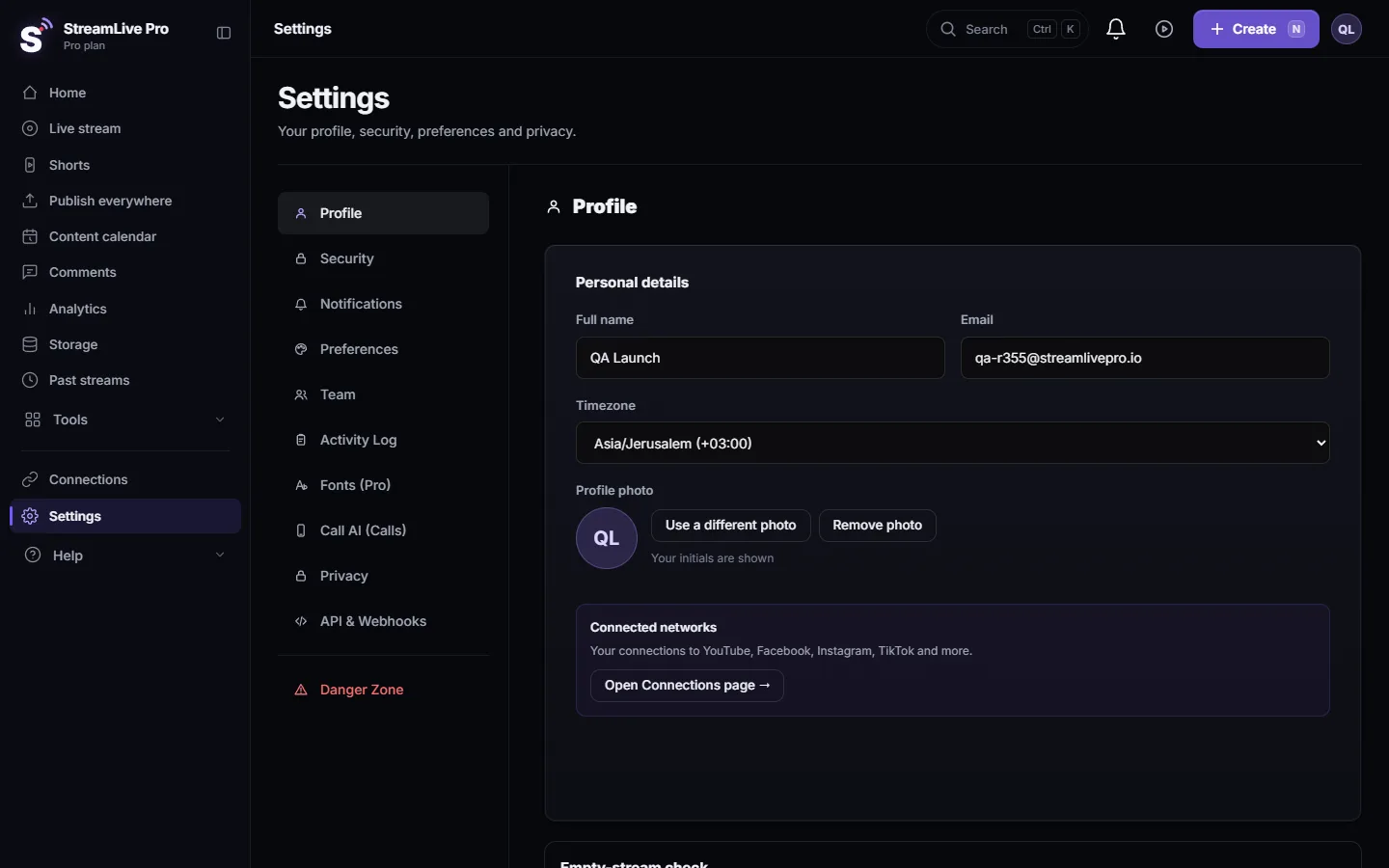
In Claude: Settings, Connectors, Add custom connector, name StreamLive Pro and the address above, then Connect and sign in. In ChatGPT: Settings, Apps, Advanced, turn on Developer mode, create an app with the address and OAuth, then sign in. In StreamLive Pro the address is also in Settings, Security, Connected apps and API, which is where you disconnect too. ChatGPT and Claude rename their menus from time to time; if something looks different, look for "connector" or "app" in their settings.
Related pages
- StreamLive Pro MCP tools: full list for ChatGPT and Claude
- Use StreamLive Pro from ChatGPT and Claude
- API keys for developers: create, use and revoke
Safety habits that make sense
- Approve only the permissions you need. If you only want results, reading is enough.
- Read previews before you approve. The assistant shows what it is about to publish. That preview is your last check.
- Disconnect what you no longer use. Access stops at once.
- Do not paste stream keys into a chat. Use the separate stream key permission, which keeps the key masked.
Frequently asked questions
What does MCP stand for?
Model Context Protocol. It is an open standard that lets AI assistants connect to apps and use the tools those apps offer.
Is MCP made only for Claude?
No. It is an open standard. ChatGPT, Claude and several code editors support it, and the same StreamLive Pro server works with both assistants.
Does the assistant get my password?
No. You sign in on StreamLive Pro's own page, and the assistant receives access limited to the permissions you approved. You can disconnect at any time.
What is the difference between MCP and an API key?
An MCP connection is for an assistant and is approved by signing in, on every plan. An API key is for your own code calling the REST API, and is on the Studio plan.
Can an assistant publish or end a live without asking me?
No. Ending a live, cancelling and publishing wait for your confirmation in the chat, and publishing first shows a preview.
Keep reading
Every StreamLive Pro REST API endpoint under /api/v1 with its parameters, request fields and answer fields: lives, chat, stream keys, Shorts, posts, analytics.
What ChatGPT and Claude can access: permissions explainedEvery permission ChatGPT or Claude can get on your StreamLive Pro account, what each one allows, which tools need it, which you can leave off, and how to change them.
StreamLive Pro MCP tools: full list for ChatGPT and ClaudeAll 24 StreamLive Pro MCP tools that ChatGPT and Claude can use: what each one does, which only read, which change things and which need your approval.
Webhooks for developers: events, signature and deliveryStreamLive Pro webhooks for developers: add an https address in Settings, receive stream.started and other events, and verify the HMAC-SHA256 signature in Node or Python.
Want to try it? 7-day trial, no credit card.
Start free