 StreamLive Pro
How to live stream a synagogue event on a weekday
Live stream a synagogue event on a weekday: a bar mitzvah at a Monday or Thursday reading, a siyum, a hachnasat sefer Torah. Rav's approval, cameras, sound, privacy.
To live stream an event in a synagogue, hold the broadcast on a weekday, get the rav's and the gabbai's approval first, point one camera at the bimah, take the sound from the speaker's microphone, and send it from a browser to a YouTube link you share with the family or the community. You schedule ahead, the live itself is on a weekday, and those who could not be there watch the recording afterwards.
This guide covers what is specific to the shul: the events, the rav's approval, where the cameras may point, and a procession that leaves the building. For a family celebration in a hall, see How to live stream a bar mitzvah or a family event. For streaming regular services, see Live stream a church or synagogue service.
Which events, and what each one needs
| Event | The moment people wait for | Camera | Sound |
|---|---|---|---|
| A bar mitzvah at a Monday, Thursday or Rosh Chodesh reading | The aliyah and the reading | From the side of the bimah, at the height of the sefer | A microphone at the bimah, or a clip-on on the boy for the speech |
| A siyum | The hadran and the speeches | On the speaker at the table | A clip-on microphone on each speaker in turn |
| A hachnasat sefer Torah | The last letters, the procession, the sefer entering the aron | A moving phone outside, a fixed camera inside | The phone's microphone outside; the shul's microphone inside |
| A community evening or a shiur | The talk | On the speaker | The shul's microphone or a clip-on |
Many communities do not stream the tefillah itself, or only some parts of it. That is the rav's decision. A common answer is to stream the speeches, the siyum or the reading, and not the prayers around them.
Before the event: approval and privacy
- Ask the rav and the gabbai what may be streamed and from where. Settle it a week before, not on the morning.
- Point the cameras at the bimah and the aron, not at the seats. Keep the women's section out of the frame entirely. People came to daven, not to be filmed.
- Choose who can watch. For a family event, YouTube set to Unlisted means only those with the link can watch it: YouTube live visibility: public, unlisted or private. For a community event, the shul's channel or Facebook Page can be public.
- Decide about Shorts in advance. After every live, StreamLive Pro cuts Shorts from the recording unless automatic Shorts are switched off. For a private family event, switch them off before the live, or set this live to fewer Shorts: Turn automatic Shorts on or off. Nothing is published until someone publishes it, but it is simpler not to make them.
Schedule it on a weekday
In Live stream choose Schedule broadcast, with a title, the date and time and the networks. A scheduled YouTube broadcast gets its link in advance, so you can send it to the family or the community group a day before: Schedule a live broadcast in advance. A live scheduled from the browser studio does not start by itself: a reminder comes 10 minutes before, and you press go live. Do not use a pre-recorded broadcast when the timing is sensitive; that kind goes out on its own at its time.
If the event must end by a set time, end with a clear margin and stop the broadcast by hand.
Sound in a shul
A shul is full of hard surfaces: stone, wood, high ceilings. A camera's microphone across the room hears the echo and the murmur, not the speaker.
- Start with the shul's own microphone when there is one at the bimah or the amud. Ask whoever runs the sound for a feed into the streaming computer, through a USB audio interface.
- Otherwise a clip-on microphone on the speaker, passed from speaker to speaker at a siyum.
- The reading of the Torah is quiet and close to the sefer. A microphone on the bimah, not one on the wall, makes it audible.
- Headphones on the operator, throughout.
More on the studio's sound controls: Sound in the browser studio: levels, mute and noise filter.
Cameras, inside and outside
- Inside, one fixed camera on a tripod at the side of the bimah, slightly above head height. It shows the reader and the sefer without the congregation behind.
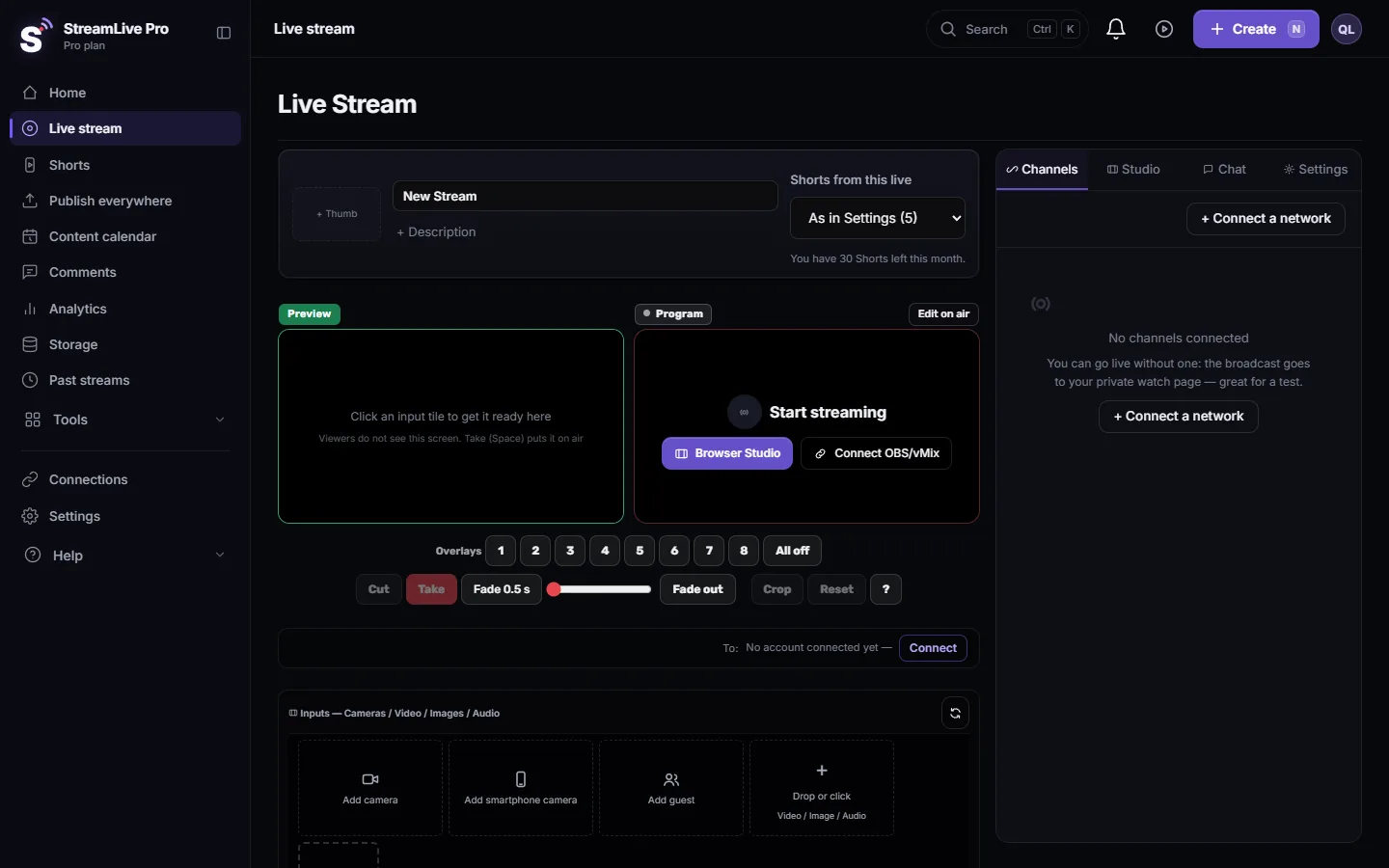
- A second phone on the speaker's place, or on the aron for the hachnasat sefer Torah. It joins by a link or a QR code: Use your phone as an extra camera. In the browser studio you prepare it on Preview and send it with Take: How to live stream with several cameras.
- Outside, for a procession, a phone held by one steady person, walking ahead of the chuppah. The phone connects over its own mobile data, so check the reception along the route the day before. Music and wind are loud outside; keep the phone close to what matters, and switch back to the fixed camera inside when the sefer enters.
Relatives who cannot come
A grandfather abroad can join the broadcast by link and say a blessing that viewers hear. For the people in the shul to hear him too, connect the streaming computer to the shul's sound system. The link is one for everyone and is valid for 4 hours, so send it on the day: Guests and invitations — bringing people into the room. Comments from YouTube and Facebook appear in one panel, if someone wants to read out greetings: Live chat from YouTube and Facebook in one panel.
After the event
- Keep the recording. Press Record at the start. Without it, the recording is removed about two hours after the live: Where is my live stream recording?.
- A clip of the speech for the family group: open the recording and cut the speech or the blessing.
- Captions for relatives abroad. In Translate and subtitles transcribe the recording, correct names and Hebrew terms, and translate into English, French, Russian or another language: English subtitles for a Hebrew video. Captions are made after the event, not during the live.
Producing with OBS, or the coming Studio
If someone in the community produces with OBS or vMix, it can send one stream to StreamLive Pro by RTMP or SRT on a paid plan, and StreamLive Pro sends it on to each network; the trial uses the browser studio: Connect OBS to StreamLive Pro and multistream. StreamLive Pro Studio, free, professional streaming software for Windows and Mac, is coming; it is in testing (version 0.5.0) and not downloadable yet. A StreamLive Pro account adds the platform: AI Shorts, scheduling, managed lives through your connected networks, and comments: StreamLive Pro: what is free and what the platform adds.
Common mistakes
- Streaming without asking the rav. Ask first, and stream only what was agreed.
- A camera that shows the seats or the women's section. Aim at the bimah and the aron.
- Testing the procession route on the day. Mobile reception outside the shul is the real test.
- Automatic Shorts left on for a private event. Switch them off before the live.
- No Record. The family will want the speech afterwards.
Where StreamLive Pro fits
StreamLive Pro runs the event from a browser: one camera or two phones, a relative abroad by link, the stream to YouTube and, if wanted, the shul's Facebook Page at the same time. Afterwards it keeps the recording when you press Record, and captions and translates the speech. It does not show live captions during the event. Plans: /pricing?lang=en.
Frequently asked questions
Can we live stream a bar mitzvah in shul?
Yes, when it is on a weekday, for example at a Monday, Thursday or Rosh Chodesh reading, and the rav agrees. If the main part cannot be streamed, share the recording of the weekday part instead.
How do we keep the congregation out of the stream?
Place the camera at the side of the bimah, aimed at the reader and the sefer, and keep the seats and the women's section out of the frame.
Can we stream a hachnasat sefer Torah procession outside?
Yes. A phone that joins as a camera over its own mobile data can walk with the procession. Check the reception along the route the day before.
Can only the family watch?
Stream to YouTube set to Unlisted and share the link in the family group. Only people with the link can watch.
Will StreamLive Pro make Shorts of our event?
After a live it cuts Shorts unless automatic Shorts are switched off. Nothing is published without you. For a private event, switch them off before the live.
Is the event recorded?
Only if you press Record. Otherwise the recording is removed about two hours after the live.
Keep reading
Live stream a bar mitzvah, a brit or another family event for relatives who cannot come: privacy, cameras, sound, the hall's internet and a plan for the day.
How to host a live Q&A session on YouTube and FacebookRun a live Q&A: collect questions before, read YouTube and Facebook chat in one panel, show a question on screen, bring in an expert by link, and reuse the answers.
How to live stream a local or youth sports gameLive stream a youth or amateur sports game with one or two phones: where to stand, sound, the score on screen, the venue's internet, privacy and highlights afterwards.
How to live stream a school ceremony or graduationHow to live stream a school ceremony or graduation: consent and privacy first, the hall's sound, phones as cameras, a link for families, and keeping the recording.
Want to try it? 7-day trial, no credit card.
Start free