 StreamLive Pro
Connect OBS to StreamLive Pro and multistream
Connect OBS to StreamLive Pro step by step: the Custom service, the output settings that pass every network, how to see you are live, and how to stop cleanly.
OBS Studio sends one stream to StreamLive Pro, and StreamLive Pro sends it on to every network you ticked. In OBS you choose the Custom service and paste a server address and a key from the Encoder card on the Live stream page. OBS itself needs no plugin for this, and your upload carries the stream once, however many networks you reach.
This page is the full OBS walk-through. Where the address and key live, and the short list of settings, are in Streaming from OBS or vMix with RTMP; this page goes through OBS screen by screen and covers what that one does not.
Before you start
- A paid plan. Encoder ingest (OBS, vMix, hardware encoders) is on the paid plans. In the 7-day trial the Encoder card shows "On paid plans" instead of an address, and the trial streams from the Browser Studio only. Plans are on the pricing page.
- Connected channels. Connect YouTube, a Facebook Page and the rest under Connections first. Instagram and TikTok need a fresh key before each live (Live on Instagram and TikTok with a stream key).
- OBS Studio installed from obsproject.com. The menu names below are OBS's own (OBS Quick Start Guide).
Steps
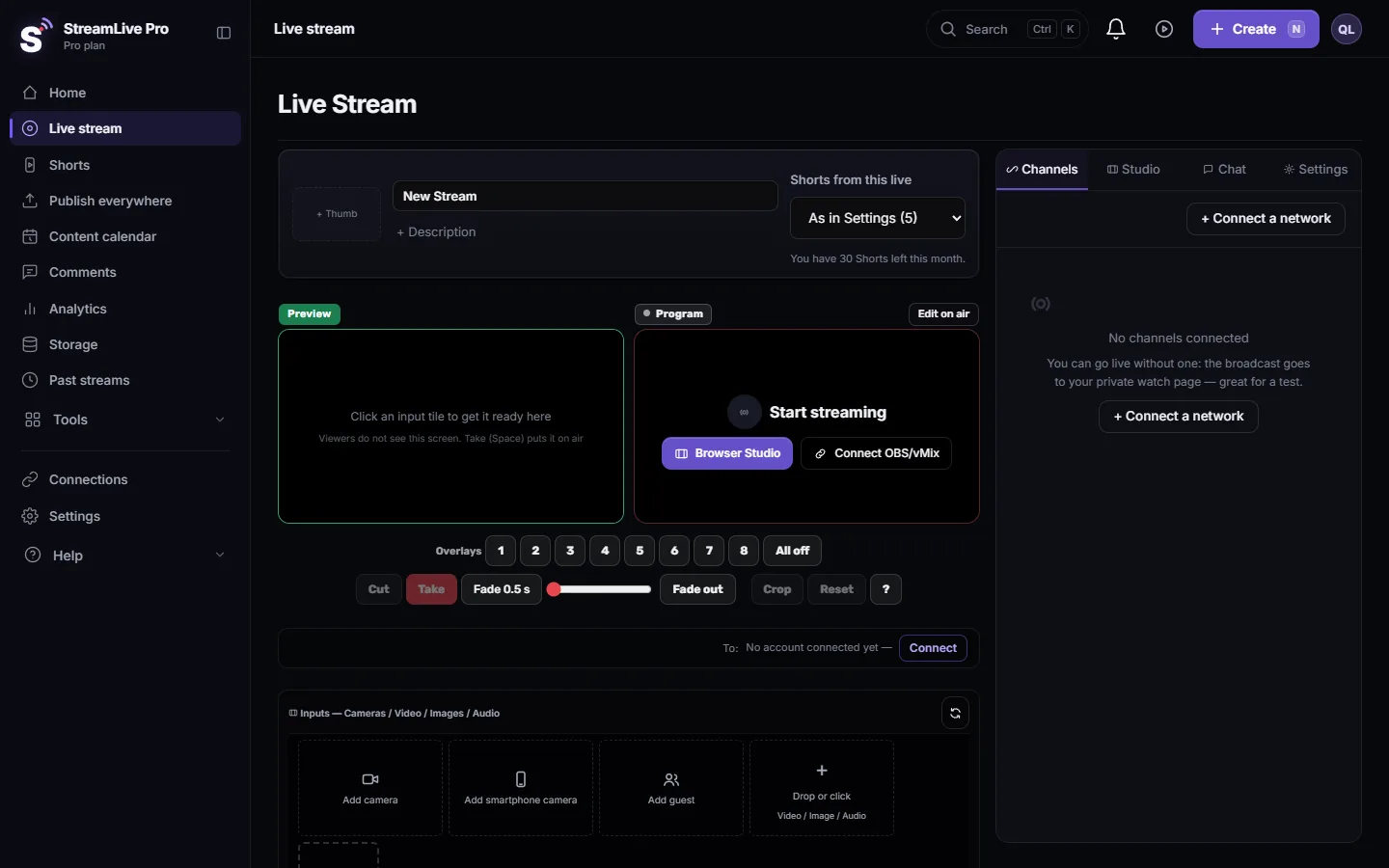
- Open the encoder panel. In StreamLive Pro click New stream at the top of the dashboard and choose Stream from software like OBS (RTMP / SRT). The Live stream page opens on the Channels tab, with the Encoder card under the preview.
- Pick the protocol tab. Use RTMPS if you are not sure: it is encrypted and runs on port 443, which almost every network allows. Use RTMP if your OBS setup or network needs it. For SRT, follow Stream with SRT from OBS, vMix or a hardware encoder.
- Copy the address and the key. Click the copy button next to the URL. The key is masked; use its own copy button rather than revealing it on screen, and never show it while you share your screen.
- Paste them into OBS. In OBS open Settings, then Stream. Set Service to Custom, paste the address into Server and the key into Stream Key. Click Apply.
- Set the output. In Settings, Output, switch Output Mode to Advanced and open the Streaming tab. Choose an H.264 encoder (x264, or the H.264 version of your graphics card's encoder), Rate Control CBR, a bitrate your upload can hold, and Keyframe Interval 2. Settings and the reasons are in OBS settings for multistreaming to several networks.
- Tick your channels. Back in StreamLive Pro, switch on every destination in the Channels list. Keep this page open and visible.
- Start Streaming in OBS. Within about ten to thirty seconds StreamLive Pro shows a message that the stream was detected and you are live, switches the preview to your incoming picture and sends the broadcast to the ticked channels.
- Stop cleanly. Press Stop stream in StreamLive Pro to end the live on every network at once, then Stop Streaming in OBS. If you only stop OBS, StreamLive Pro waits a few minutes (by default) for the signal to come back before it ends the broadcast by itself.
Two settings that cause most failures
Video codec. StreamLive Pro receives encoder streams through Cloudflare Stream, which accepts H.264 video and AAC audio only (Cloudflare Stream: Start a live stream, checked 5 November 2026). Recent OBS versions also offer HEVC and AV1 encoders. Those can connect and still give you no picture. Pick an encoder whose name says H.264 (for example "NVIDIA NVENC H.264" or "x264").
Keyframe interval. The same page requires a keyframe interval between 2 and 10 seconds, and YouTube asks for 2 and no more than 4 (YouTube Help: live encoder settings). OBS's default of 0 means "auto". Type 2.
Watching the right things
- The preview in StreamLive Pro lags. It is built in segments and typically trails OBS by ten to thirty seconds. Judge your picture by OBS and by the network, not by this preview.
- The OBS status bar shows dropped frames. A number that keeps rising means the bitrate is too high for your upload. Lower it one step.
- If no channel is ticked, StreamLive Pro warns that no destination was selected. The stream reaches us but goes nowhere until you tick channels.
What can go wrong
| Symptom | Fix |
|---|---|
| OBS cannot connect | Copy the address again with the copy button. Switch to the RTMPS tab if port 1935 is blocked where you are. |
| OBS is streaming, StreamLive Pro does not go live | Check the key belongs to this broadcast, and wait up to thirty seconds. Then see My encoder says it is streaming, but there is no picture. |
| Connected, but black or no picture | Use an H.264 encoder and Keyframe Interval 2. |
| Live on some networks only | Check the red cards in the channel list: usually an expired connection or a used Instagram or TikTok key. |
| Stutter on every network together | Your upload cannot hold the bitrate. Lower it; see Upload speed and bitrate for multistreaming. |
Frequently asked questions
Do I need an OBS multistream plugin?
No. OBS sends one stream to StreamLive Pro and the copies to each network are made on our servers. Your upload carries the stream once.
Which OBS service do I choose?
Custom. Paste the address from the Encoder card into Server and the key into Stream Key.
RTMP or RTMPS in OBS?
RTMPS when you can. It is encrypted and runs on port 443, which passes through almost every network. Use RTMP only if something in your setup needs it.
Can I use OBS during the trial?
No. The 7-day trial streams from the browser studio only, and the Encoder card shows that encoders are on paid plans.
Why does OBS say live but my channels show nothing?
Usually no channel is ticked, the key is from another broadcast, or OBS is sending HEVC or AV1. Tick the channels, copy the current key, and choose an H.264 encoder.
Keep reading
Stream a game to Twitch, Kick and YouTube at once: OBS sends one stream, StreamLive Pro sends it on, plus chat, upload, platform rules and Shorts of your best moments.
What is an ingest server in live streaming?What is an ingest server: the address your encoder sends a live stream to, with a stream key. How ingest differs from playback, what it checks, and where to find yours.
Connect PRISM Live Studio to StreamLive ProAdd StreamLive Pro as a custom channel in PRISM Live Studio on the computer and send one stream to YouTube, Facebook Pages, Twitch and more: steps, settings and fixes.
Connect XSplit Broadcaster to StreamLive ProAdd a Custom RTMP output in XSplit Broadcaster with StreamLive Pro's address and key, and reach YouTube, Facebook Pages, Twitch and more from one stream: steps and fixes.
Want to try it? 7-day trial, no credit card.
Start free