 StreamLive Pro
How to live stream a bar mitzvah or a family event
Live stream a bar mitzvah, a brit or another family event for relatives who cannot come: privacy, cameras, sound, the hall's internet and a plan for the day.
A grandfather in another country, an uncle in hospital, cousins who could not get a flight: for a family event, the live stream is for a few dozen people who matter a great deal and will forgive a lot, except missing the moment itself. That changes the priorities. Sound you can hear and a link that works matter more than a second camera. Privacy matters more than reach.
This guide covers a bar mitzvah, a brit, a family celebration or a wedding hall, held on a weekday. If the main moment cannot be streamed, plan to stream another part of the celebration, or record and share afterwards.
Decide three things first
| Question | Simple answer | When to do more |
|---|---|---|
| Who watches? | Family, by private link | A community page that wants to show it publicly |
| Where? | YouTube, set to Unlisted | Also a Facebook Page, if the community has one |
| What equipment? | One phone on a tripod, close to the speaker, plus a microphone | A second phone for the room, a guest joining from abroad |
Unlisted on YouTube means the video can be seen and shared by anyone with the link (YouTube's privacy settings). For a family event that is usually the right balance: easy to open from WhatsApp, not public. Facebook live in StreamLive Pro goes to a Page you manage, not to a personal profile or a group.
What you need
- A phone or a laptop with a camera. The phone browser works today; the StreamLive Pro app is not in the app stores yet.
- A tripod or a stable stand. A hand-held phone for an hour is shaky and tiring.
- A microphone near the speaker. A clip-on microphone on the bar mitzvah boy or on whoever gives the speech does more for the stream than any camera. The room's PA speakers are loud in the hall and muddy on the stream.
- Power. A charger and a long cable or a power bank. A one-hour stream drains a phone.
- Internet. The hall's Wi-Fi or a mobile connection. You upload one stream; StreamLive Pro sends it to each destination from its servers, so two destinations do not need twice the upload. Background: Upload speed and bitrate for multistreaming.
- An account. The 7-day trial allows 2 broadcasts of up to 60 minutes each, to 2 destinations, from the browser studio. For a longer event or a second rehearsal, look at the /pricing?lang=en.
Steps
- Connect YouTube a few days before. In Connections sign in with the family's YouTube channel. A channel that never went live must have live streaming enabled first, and the first time can take up to 24 hours; see How to go live on YouTube from your computer.
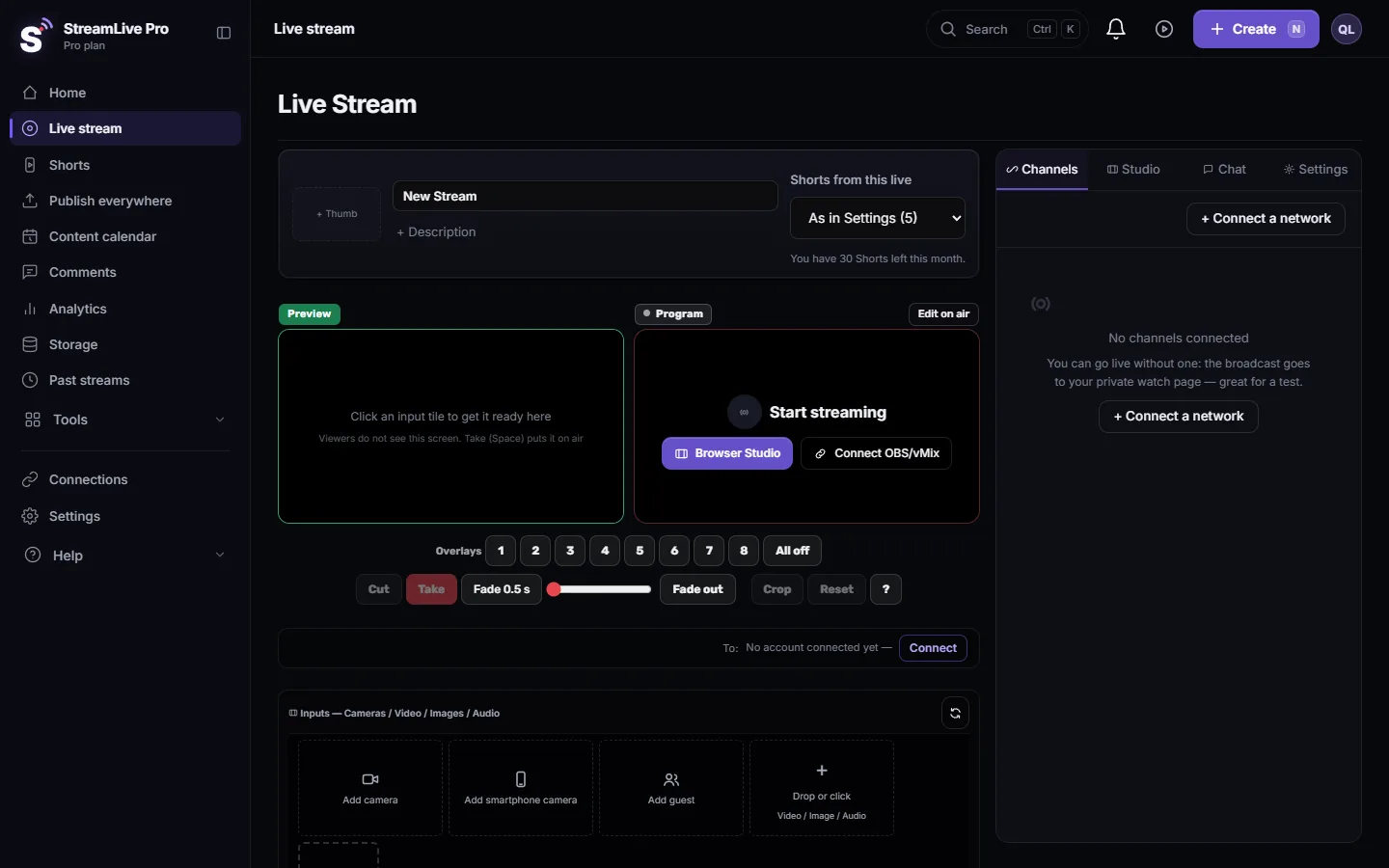
- Schedule the broadcast. In Live stream choose Schedule broadcast, set the title (for example "Our son's bar mitzvah"), the date and time, and Unlisted visibility. A scheduled YouTube broadcast gets its link in advance; see Schedule a live broadcast in advance.
- Send the link once. Post it in the family WhatsApp group the day before, with the start time in the relatives' own time zones. Pin it.
- Test in the hall. Arrive early, put the phone where it will stand, and run a short private test: check picture, sound from the speaker's microphone, and that the stream holds when the hall fills with phones. The 10-second camera check before you go live helps here.
- Add a second camera if you have one. A second phone can join as a camera through a link or QR code, for example one on the speaker and one on the room. See Use your phone as an extra camera.
- Invite a relative from abroad, if wanted. A grandfather can join the broadcast as a guest by link and say a blessing that viewers of the stream hear. For the hall to hear it too, connect the computer running the studio to the hall's sound system. The link is one for everyone and works for 4 hours, so send it on the day. See Guests and invitations — bringing people into the room.
- Press Record. If you want to keep the full video, press Record in the studio. Without it, the recording is removed about two hours after the broadcast.
- Go live 10 minutes early. A still picture of the hall with soft music gives relatives time to open the link before the speech.
- Afterwards, share the recording. Keep the full video, and cut the speech or the blessing as a short clip for those who missed it.
Sound: the part people notice
Viewers forgive a soft picture; they leave when they cannot hear the speech. Put the microphone on the speaker, not on the table. Keep the phone away from the DJ's speakers. Ask the DJ to lower the music during speeches, and agree a signal. If several people speak from one lectern, place the microphone there. A guest who joins by link hears the room through your microphone, so the same rule helps them too.
Common mistakes
- Testing at home instead of in the hall. The hall's Wi-Fi, full of guests' phones, is the real test.
- Public instead of Unlisted. A family event does not need strangers; choose Unlisted and share the link.
- No Record pressed. The full recording is kept only if you pressed Record.
- A phone that sleeps or rings. Turn on Do Not Disturb and keep the screen awake.
- The trial's hour. A trial broadcast stops at 60 minutes. For a longer event, plan for a paid plan.
- Streaming the whole evening. An hour of dancing is long for viewers at a screen. Stream the ceremony and the speeches; keep the rest for the recording.
After the event: captions for relatives abroad
Relatives who do not speak Hebrew can get the speech with captions. Open the recording in Translate and subtitles, correct the Hebrew transcript, and translate it into English, Russian, French or another language; see English subtitles for a Hebrew video. Captions are made after the event, not during the live.
Where StreamLive Pro fits
StreamLive Pro runs the stream from a browser: the phone or laptop sends one stream, and it goes to YouTube and, if you want, a Facebook Page at the same time. It adds a second phone as a camera, lets a relative join by link, keeps the recording when you press Record, and can caption and translate the speech afterwards. It does not show live captions during the broadcast, and the phone app is not in the stores yet. More: /multistream?lang=en.
Frequently asked questions
Can I live stream a bar mitzvah privately?
Yes. Stream to YouTube with the visibility set to Unlisted. Only people with the link can watch, and you share it in the family group.
Do I need a professional camera?
No. A modern phone on a tripod with a microphone near the speaker is enough for family viewers. Sound matters more than picture.
Can a relative abroad speak during the stream?
Yes. Send a guest link on the day of the event; the link is valid for 4 hours. The relative appears in the broadcast; for the hall to hear too, connect the studio computer to the hall's sound system.
Is the event recorded automatically?
Only if you press Record in the studio. Otherwise the recording is removed about two hours after the broadcast.
Can I stream to Facebook too?
Yes, to a Facebook Page you manage, at the same time as YouTube. Live to a personal profile or a group is not supported.
Will the trial be enough for the event?
The trial allows two broadcasts of up to 60 minutes each to two destinations. For a longer ceremony or a rehearsal, see the plans.
Keep reading
Live stream a synagogue event on a weekday: a bar mitzvah at a Monday or Thursday reading, a siyum, a hachnasat sefer Torah. Rav's approval, cameras, sound, privacy.
How to host a live Q&A session on YouTube and FacebookRun a live Q&A: collect questions before, read YouTube and Facebook chat in one panel, show a question on screen, bring in an expert by link, and reuse the answers.
How to live stream a local or youth sports gameLive stream a youth or amateur sports game with one or two phones: where to stand, sound, the score on screen, the venue's internet, privacy and highlights afterwards.
What is stream latency, and where does the delay come from?Stream latency explained: the delay between your camera and your viewers, where each second comes from, YouTube's latency options, and how to live with it.
Want to try it? 7-day trial, no credit card.
Start free