 StreamLive Pro
Stream a game console to many networks with a capture card
Stream a PlayStation, Xbox or Switch to YouTube, Twitch and Kick at once: console into a capture card, the card into the browser studio, game sound and your voice.
To stream a console to several networks at once, send its HDMI output into a USB capture card on a computer, add the card as a camera in the browser studio, and go live to every network you connected. The console plays as usual on your TV or monitor through the card's pass-through output, if the card has one, while the studio sends the picture, the game sound and your microphone as one stream. Our servers pass it on to YouTube, Twitch, Kick and the rest.
This guide uses a computer. A console's own built-in streaming is set up on the console and is not covered here.
Before you start
- A capture card on a computer. Set it up as in Connect an HDMI capture card to the browser studio. StreamLive Pro does not test or recommend card models.
- The console's copy protection (HDCP). Some consoles protect their HDMI output, and a card then shows black. Elgato's guide for the PlayStation 5 says to turn HDCP off under Settings, System, HDMI, with the console connected straight to a TV or monitor, not through the card (Elgato: set up Game Capture 4K S with PlayStation 5, checked 5 November 2026). For other consoles, follow the console maker's own help.
- Your networks are connected. Open Connections and connect YouTube, Twitch, Kick or any other network: How to live stream to several platforms at once.
- A microphone for your voice. A headset or USB microphone on the computer.
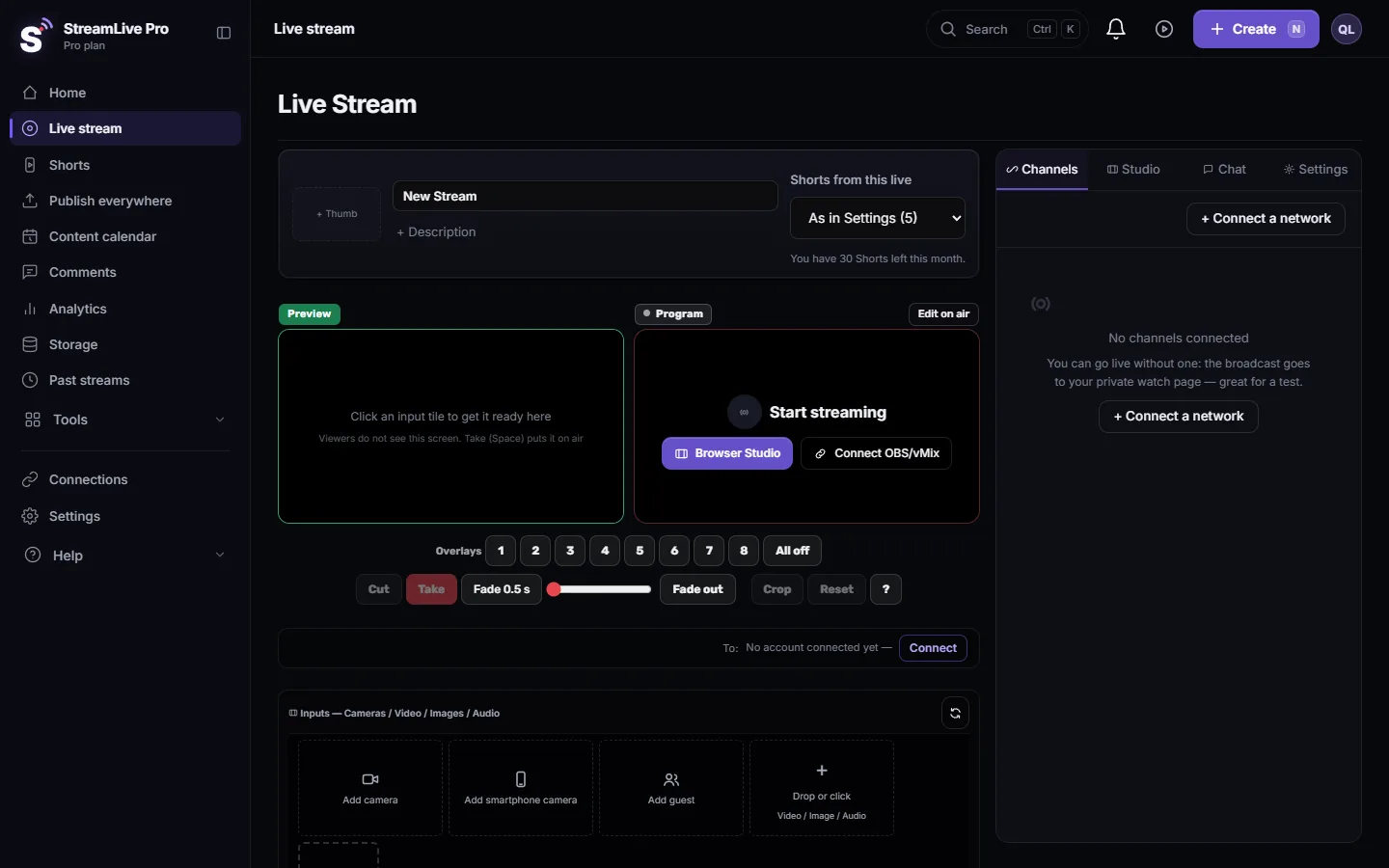
- The browser studio is open. Choose Live stream, start a new live and pick Browser Studio.
Steps
- Connect the console. Console HDMI to the card's input. If the card has an HDMI output (pass-through), connect it to your TV or monitor so you play without the browser's delay.
- Plug the card into the computer. Use a USB port on the computer itself. The studio refreshes its camera lists and shows Detected with the card's name the first time.
- Add the card. Open Add input, press Camera, pick the card in the Camera list.
- Pick the game sound. In the Microphone list choose the card's audio device, so the game sound comes with the picture. Press Add.
- No game sound on the tile? Press Choose microphone on the tile and pick the card's audio device.
- Use your headset for your voice. Your own studio microphone is heard all the time unless you mute it, while the game sound on the card's tile is heard only while that tile is on air. Use a headset or USB microphone as your own microphone and set the levels so your voice sits above the game: Sound in the browser studio: levels, mute and noise filter.
- Add a face camera (optional). Add a webcam as a second tile with No microphone, and place it in a corner of the game picture: Side by side and picture in picture layouts in a live.
- Take the game to air and go live. Click the card's tile, press Take, then start the live. Every connected network gets the same stream.
Game sound and party chat
The card can only carry the sound the console sends over HDMI. Elgato's PlayStation 5 guide warns that when a headset is plugged into the controller, the console moves all the sound (game and voice) to the controller, and the card no longer receives it (Elgato: set up Game Capture 4K S with PlayStation 5, checked 5 November 2026). Their guide suggests plugging the headset into the computer instead. In StreamLive Pro that headset is then simply your own microphone.
What can go wrong
- Black tile with a console. Copy protection is on, or the console sends a format the card cannot read. See My capture card shows a black screen or has no sound.
- Picture, no game sound. The wrong audio device was picked, or the console sends its sound to the controller. Use Choose microphone and check the console's audio output.
- The game sound stops when you switch to the face camera. A camera's sound is heard only while that camera is on air. Keep the game on Program and show your face in a corner instead of cutting away.
- The game looks soft on the networks. The broadcast size is set in the live's settings; a card in 4K mode may send less than you expect. See My camera picture is low resolution in the studio.
- One network did not start. Check that network under Connections and see My live reached only some of the networks.
If you build your scenes in OBS, the same networks work through OBS instead: How to stream a game to Twitch, Kick and YouTube at once.
Frequently asked questions
Can I stream my PS5 to YouTube and Twitch at the same time?
Yes, through a capture card on a computer. The browser studio sends one stream and StreamLive Pro passes it to both networks.
Do I need OBS to stream a console?
No. The browser studio reads the capture card directly. OBS is an option if you already build your scenes there.
Can I play without lag?
Play on the TV through the card's pass-through output if it has one. The browser preview is always a little behind.
Will my voice and the game be separate?
Yes. The game sound comes in on the card's tile with its own level, and your own microphone has its own level and mute.
Does a console stream need more upload speed than a camera?
The studio sends one stream at the size set for the live, whatever the source. Fast games look better with more bitrate, so test before a long session.
Keep reading
Live streaming software for beginners: why a browser studio is the easiest start, a first live in eight steps, the camera check, and the mistakes to avoid.
How to live stream a music performance with good soundLive stream a concert or a music performance with good sound: take audio from the mixer, switch off voice processing, set levels, and send it to several networks.
How to multistream: the complete guide to several networksHow to multistream to several platforms at once: your own keys from your computer, or one upload sent on by a server. Upload needs, network rules and pair guides.
How to live stream: the complete guide for 2026How to live stream in 2026: pick a device, connect your networks, choose a studio and the gear, run the checklist, then go live. Links to every detailed guide.
Want to try it? 7-day trial, no credit card.
Start free