 StreamLive Pro
Connect an HDMI capture card to the browser studio
Use an HDMI capture card in the browser studio on a computer: plug it in, pick it as a camera, choose its sound, and stream it to every network at once.
A USB capture card turns an HDMI signal (a camera, a console, a second computer) into something the browser sees as a camera. So in the browser studio on a computer you add it like a webcam: plug it in, open Add input, press Camera and pick the card in the list. Choose the card's own sound as the microphone, put the tile on air, and the studio sends that one picture to every network you connected.
This page is about a computer (Windows, Mac or Linux) with Chrome, Edge or another current browser. It does not cover a capture card on a phone or a tablet.
Before you start
- A computer with a free USB port. Plug the card into a port on the computer itself. A hub shared with other cameras can starve it of bandwidth.
- The HDMI source is on and sending a picture. A camera needs a clean HDMI output (no menus on screen): Use a DSLR or mirrorless camera for live streaming. A console may need its copy protection (HDCP) off: Stream a game console to many networks with a capture card.
- No other program holds the card. Close OBS, the card maker's own app, Zoom, Teams and any other tab that shows the card's picture. A device can usually be open in one place at a time.
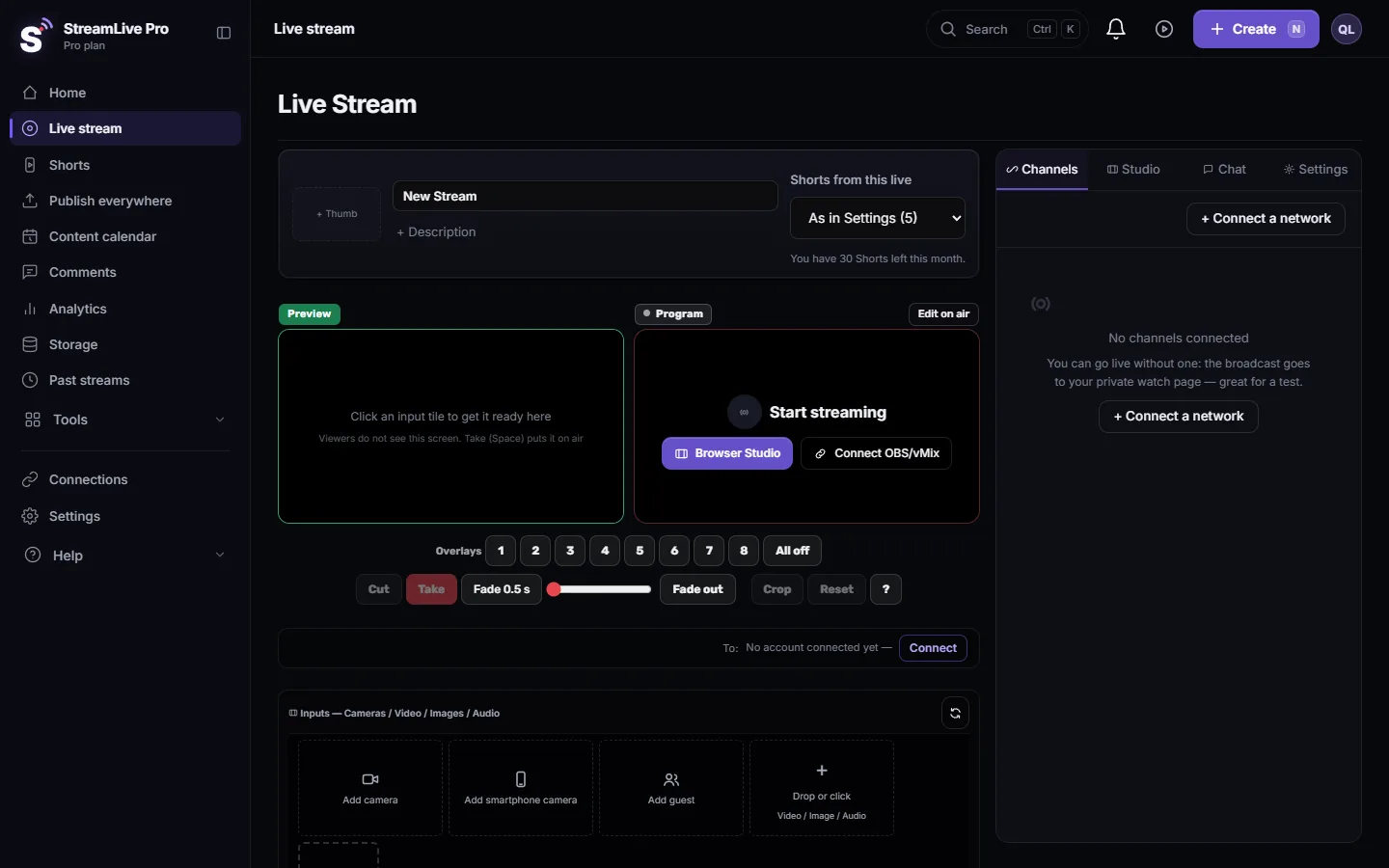
- The browser studio is open. Choose Live stream, start a new live and pick Browser Studio. Allow the camera and microphone when the browser asks.
- Any plan, including the trial. A capture card is a camera input like any other.
Steps
- Plug in the card and the HDMI cable. You can do this with the studio already open. When the browser reports a new device, the studio refreshes its camera lists by itself, and the first time it sees a capture card it shows a short message, Detected, with the card's name.
- Open the camera window. In the bar under the picture open Add input and press Camera, or click the Add camera tile in the inputs strip. The window Add Camera to Studio shows how many cameras and microphones it found.
- Pick the card in the Camera list. It carries the name the card reports, for example the maker and model. If it is missing, press Refresh: the window reads the devices again.
- Pick the card's sound in the Microphone list. Many cards appear twice: once as a camera and once as an audio device with a similar name. Choose that audio device here so the sound of the HDMI source travels with its picture. The list starts on the first microphone it found, so check this before you press Add.
- Press Add. The card becomes a tile. Cards from some makers take a few seconds to deliver the first picture; the message then says the studio is waiting for the source, up to 5 seconds.
- No sound on the tile? Choose microphone. A tile without audio shows a Choose microphone button. Press it, pick the card's audio device in the window Microphone for this input, and the sound goes to that tile with its own level. The choice is remembered for that camera in this browser.
- Put it on air. Click the tile to put it on Preview, check picture and sound, then press Take or Cut: Preview, Program, Take and Cut explained.
- Go live to your networks. The studio sends one stream and our servers pass it to every connected network: How to live stream to several platforms at once.
What size and frame rate you get
The studio asks a camera for 1920x1080 at 30 frames per second and settles for less only when the device cannot deliver it. For sources it recognises as professional capture (for example names that contain Magewell, AverMedia, Blackmagic or Decklink) it first asks with no size at all, because those devices hand over their own format more reliably that way. Either way the picture is never larger than what the card offers. The broadcast size itself is set in the live's settings: My camera picture is low resolution in the studio.
If your HDMI source sends 4K or 60 frames per second, what reaches the browser depends on the card. Because the studio asks for 1080p at 30 frames, a source set to 1080p avoids an extra scaling step.
What can go wrong
- The card is not in the list. It is held by another program, or plugged into a hub. Close the other program, move the card to a port on the computer and press Refresh. More checks: My camera does not work in the browser.
- The tile is black. The HDMI source sends nothing the card can read, or the source is protected. Full checklist: My capture card shows a black screen or has no sound.
- Picture but no sound. The wrong microphone was chosen in step 4. Use Choose microphone on the tile and pick the card's audio device.
- The tile says Camera disconnected. The USB cable moved or the card lost power. Press Reconnect on the tile.
- Two cards stutter together. Each card needs its own share of USB bandwidth. Put them on different ports on the computer.
Before every live, run The 10-second camera check before you go live. For several cameras at once, see How to live stream with several cameras and Add a camera to the browser studio.
Frequently asked questions
Do I need OBS to use a capture card with StreamLive Pro?
No. In the browser studio the card is a camera input. OBS is one more option if you already build your show there.
Which capture cards work?
Cards that appear to the computer as a USB camera (UVC). StreamLive Pro does not test or recommend specific models; if the card shows up as a camera in your browser, the studio can use it.
Can I use two capture cards?
Yes. Each one becomes its own tile, as long as the computer and its USB ports can carry both.
Does a capture card need more upload speed?
No. The studio still sends one stream, and our servers send it on to every network.
Can I use a capture card with my phone or iPad?
Not with StreamLive Pro today. This guide is for the browser studio on a computer.
Keep reading
Go live from a Mac with nothing to install: the browser studio in Safari or Chrome, the macOS permissions to allow, and when an app is still better.
Resolution and frame rate for live streamingResolution and frame rate for live streaming in plain words: 720p or 1080p, 30 or 60 fps, how both drive bitrate, and how to set them in StreamLive Pro and OBS.
How to live stream a panel discussionHow to live stream a panel discussion with remote speakers: invites, layouts for three to five people, a moderator's run sheet, audience questions on screen, and Shorts.
How to live stream a cooking show with two camerasHow to live stream a cooking show with two cameras: a phone overhead on the pan, the cook's face, picture in picture, sound in a noisy kitchen, and Shorts of each recipe.
Want to try it? 7-day trial, no credit card.
Start free