 StreamLive Pro
Resolution and frame rate for live streaming
Resolution and frame rate for live streaming in plain words: 720p or 1080p, 30 or 60 fps, how both drive bitrate, and how to set them in StreamLive Pro and OBS.
Resolution is how many pixels each frame of your video has: 1280 by 720 is called 720p, 1920 by 1080 is 1080p. Frame rate is how many frames are shown each second, written as fps: 24, 30 or 60 are the common values. Together they decide how sharp and how smooth the live looks, and together they decide how much bitrate, and so how much upload, the stream needs. For a talking show, 1080p at 30 fps is a safe default; drop to 720p before you drop the frame rate when the line is weak.
Shorter definitions of related terms are in the Live streaming glossary: the terms you will meet.
Common resolutions
| Name | Pixels | Where it fits |
|---|---|---|
| 480p (SD) | 854 x 480 | Very weak lines, mobile data |
| 720p (HD) | 1280 x 720 | A safe choice on a modest upload |
| 1080p (Full HD) | 1920 x 1080 | The usual target for a live today |
| 4K (Ultra HD) | 3840 x 2160 | Large screens and recordings; needs a strong upload and camera |
The "p" stands for progressive: each frame is a whole picture. For vertical video (9:16) the numbers swap, for example 1080 x 1920.
Common frame rates
| Rate | Looks like | Use it for |
|---|---|---|
| 24 fps | Film motion | Pre-recorded, cinematic content |
| 30 fps | Normal video | Speech, classes, interviews, slides |
| 60 fps | Very smooth motion | Sport, games, fast music performance |
Higher is not always better. A talking head at 60 fps looks almost the same as at 30 fps, but needs a bigger share of the bitrate.
How resolution and frame rate drive bitrate
Every extra pixel and every extra frame is more information to compress. As a rough guide, 1080p has 2.25 times the pixels of 720p, and 60 fps is twice the frames of 30. The encoder needs more bitrate to keep the same look, and your upload has to carry it. YouTube, for example, lists for H.264 a minimum of 3 Mbps and a recommended 8 Mbps for 720p at 30 fps, and a minimum of 5 Mbps and a recommended 14 Mbps for 1080p at 30 fps, with higher values for 60 fps (YouTube Help: live encoder settings, checked 5 November 2026). When you send to several networks, the receiving side also counts: Cloudflare Stream, which receives encoder streams for StreamLive Pro, accepts a combined bitrate between 2 and 14 Mbps (Cloudflare Stream: Start a live stream, checked 5 November 2026). Bitrate in depth: What is bitrate in live streaming?.
A higher resolution at a starved bitrate looks worse than a lower one with enough bits. A clean 720p beats a blocky 1080p.
Where you set them in StreamLive Pro
Browser studio. On the Live stream page, the Settings tab has Stream Quality: Resolution (1080p, 720p, 480p or 4K), Frame Rate (30, 60 or 24 fps) and Bitrate, where Auto is recommended. The defaults are 1080p and 30 fps. The studio reads what each camera can actually deliver and does not ask a camera for more than it supports, which avoids flicker on cameras that top out at 720p.
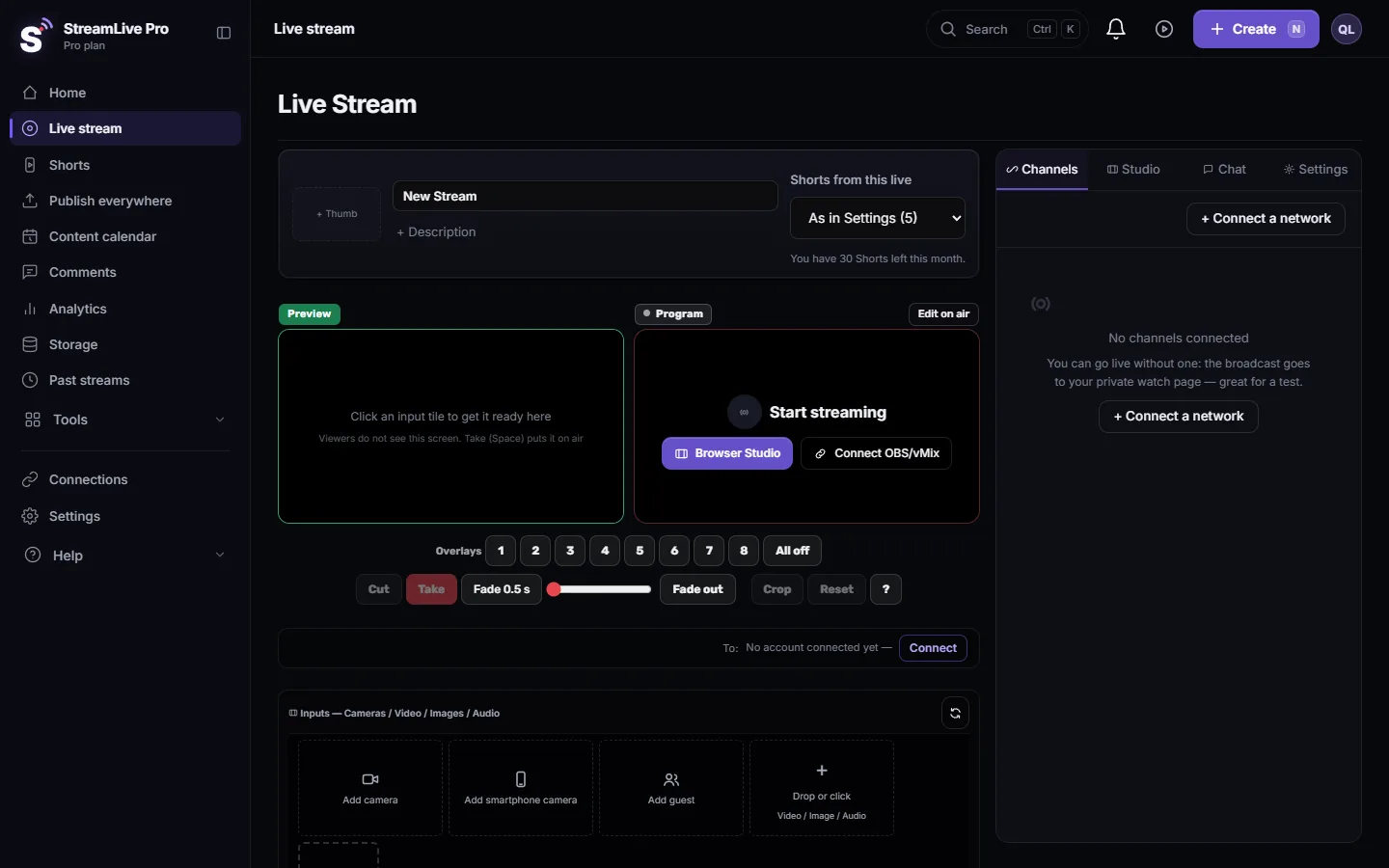
From an encoder. With OBS, vMix, an ATEM or FFmpeg you set resolution and frame rate in the encoder. StreamLive Pro passes the stream on as it arrives. OBS settings for several networks: OBS settings for multistreaming to several networks.
Recording and exports. 4K recording is on Pro and Studio. When you export from the video editor you choose 4K, 1080p, 720p or 480p, and the export never goes above the resolution of the source: Export a video in 4K from the editor.
The camera sets the ceiling
A setting cannot add detail the camera does not capture. Many built-in laptop cameras deliver 720p, and many webcams give 1080p only at 30 fps. If you pick 1080p at 60 fps and the camera cannot do it, you get a stretched 720p or a lower frame rate. A camera through a capture card is set by the camera's own output.
Light matters as much: in a dark room many cameras lower their frame rate by themselves to expose longer, and the picture looks choppy whatever you chose.
Resolution, frame rate and the computer
The browser studio composes the program on your computer before it sends it. Two cameras, a screen share and graphics at 1080p and 60 fps ask much more of the processor and the graphics chip than one camera at 720p and 30 fps. On a laptop that runs hot, the fan spins up, frames are skipped and the sound can drift. If the studio feels slow, lower the frame rate to 30 first, then the resolution, and close other heavy programs. With an encoder such as OBS the same is true, and hardware video encoding helps: What is an encoder in live streaming?.
Choosing for your show
| Show | Resolution | Frame rate |
|---|---|---|
| Class or lecture with slides | 1080p | 30 |
| Interview or podcast | 1080p | 30 |
| Live music with movement | 1080p | 60 if the upload allows, otherwise 30 |
| Sport | 1080p or 720p | 60 |
| Weak or mobile connection | 720p | 30 |
Then test for twenty minutes on the real connection and watch for dropped frames: My live stream drops frames or keeps buffering.
Vertical networks and resolution
One broadcast has one picture shape. A horizontal 16:9 live sent to a vertical network is shown with bars or cropped by that network. Safe-frame guides in the studio help you keep the important part inside a 9:16 or 1:1 crop: Safe-zone guides for vertical and square viewers. Vertical Shorts are cut from the broadcast afterwards.
Frequently asked questions
Should I stream in 720p or 1080p?
1080p if your upload holds the bitrate it needs, 720p if it does not. A steady 720p looks better than a 1080p that stalls.
Is 60 fps better than 30 fps for live streaming?
Only for fast motion such as sport or games. For speech, 30 fps looks almost the same and leaves more bitrate for detail.
What resolution does the StreamLive Pro browser studio use?
1080p at 30 fps by default. You can choose 720p, 480p or 4K, and 24 or 60 fps, in the Stream Quality settings.
Why does my live look worse at a higher resolution?
The bitrate is too low for that many pixels, so the encoder throws detail away. Lower the resolution or raise the bitrate within your upload.
Can I stream in 4K?
The studio offers 4K, but the camera, the computer and the upload all have to keep up. 4K recording is on Pro and Studio.
Keep reading
Go live from a Mac with nothing to install: the browser studio in Safari or Chrome, the macOS permissions to allow, and when an app is still better.
Live stream checklist: before, during and afterA printable live stream checklist: test broadcasts, stream keys, sound check, backup internet, what to do if the stream drops, and the work after it ends.
Upload speed and bitrate for multistreamingYouTube's bitrate table for 720p to 4K, the upload you need to multistream from OBS vs a relay, CBR and 2-second keyframes, and how to test your connection.
Ecamm Live for Windows: does it exist, what to use insteadIs there Ecamm Live for Windows? Ecamm says it is built for Mac. What Windows users use instead: vMix, OBS, Streamlabs, a browser studio, StreamLive Pro Studio.
Want to try it? 7-day trial, no credit card.
Start free