 StreamLive Pro
What is stream latency, and where does the delay come from?
Stream latency explained: the delay between your camera and your viewers, where each second comes from, YouTube's latency options, and how to live with it.
Stream latency is the delay between something happening in front of your camera and your viewers seeing it. In live streaming to social networks it is usually several seconds and can reach half a minute or more. It is normal: every step that makes a live stream reliable for thousands of viewers adds a little waiting time. What matters is knowing where it comes from, so you can tell normal delay from a problem and plan your show around it.
This page covers the term in depth. Shorter definitions of the related terms are in the Live streaming glossary: the terms you will meet.
Where the delay comes from
Engineers call the whole distance glass-to-glass latency: from the glass of the camera lens to the glass of the viewer's screen. A live picture passes through a chain on that way, and each link holds it for a moment:
| Step | What happens | Adds delay because |
|---|---|---|
| Capture and encoding | Camera frames are compressed by the encoder | Encoders look at several frames before sending |
| Upload | The stream travels from you to the ingest server | Distance, and buffering on a busy line |
| Relay | A service such as StreamLive Pro passes it on to each network | One more hop |
| The network's processing | YouTube, Facebook and others prepare the stream for every device | Re-encoding into several qualities |
| Delivery in segments | The video is cut into short pieces, each starting with a keyframe | A piece must be complete before it is sent |
| The viewer's player | The player keeps a few pieces in reserve | The reserve protects against buffering |
The last two steps usually add the most. Players keep a reserve so that a short dip in the viewer's own connection does not freeze the picture. Less reserve means less delay and more buffering for viewers on weak connections.
How networks trade delay for smoothness
Networks let you choose the balance on their side. YouTube, for example, offers three latency settings for a live stream (YouTube Help: live stream latency, checked 5 November 2026):
- Normal latency. For streams where you do not plan to interact. YouTube calls it the highest quality setting for viewers, with the least buffering, and supports all resolutions and live features with it.
- Low latency. For limited interaction. Most viewers see a delay under 10 seconds.
- Ultra-low latency. For conversations with the audience. Most viewers see a delay under 5 seconds, and YouTube says it can increase the chance of buffering.
Other networks have their own approaches and do not always offer a choice. Because every network processes and delivers the stream in its own way, viewers on YouTube and on Facebook watching the same multistream see it at slightly different moments.
Latency is not buffering, and not lag
These words are often mixed up:
- Latency is a steady delay. The picture is smooth, just late.
- Buffering is the player stopping to wait for data, usually because of the viewer's connection or a stream that does not arrive steadily.
- Dropped frames happen on the sending side, when your upload or computer cannot keep up. Viewers see stutter on every network at once (My live stream drops frames or keeps buffering).
Lowering latency does not fix buffering. Often it does the reverse, because there is less reserve to absorb a dip.
What affects it on your side
- Keyframe interval. Live video is cut into pieces at keyframes, so a long interval makes longer pieces and more delay. Cloudflare Stream, which receives encoder streams for StreamLive Pro, suggests a GOP of 2 to 4 seconds when low delay matters, against 4 to 8 for efficiency (Cloudflare Stream: Start a live stream). For multistreaming, 2 seconds suits every common destination (What is a keyframe interval, and why set it to 2?).
- A steady upload. A connection that keeps stalling builds up delay in the encoder's buffer.
- The protocol of the first leg. SRT has its own setting called latency, which is a different thing: a short buffer that gives lost packets time to be resent (Stream with SRT from OBS, vMix or a hardware encoder). WHIP aims for very low delay on the first leg only, and viewers on the networks still watch through each network's player (WHIP from OBS to StreamLive Pro: beta status and setup).
Latency in StreamLive Pro
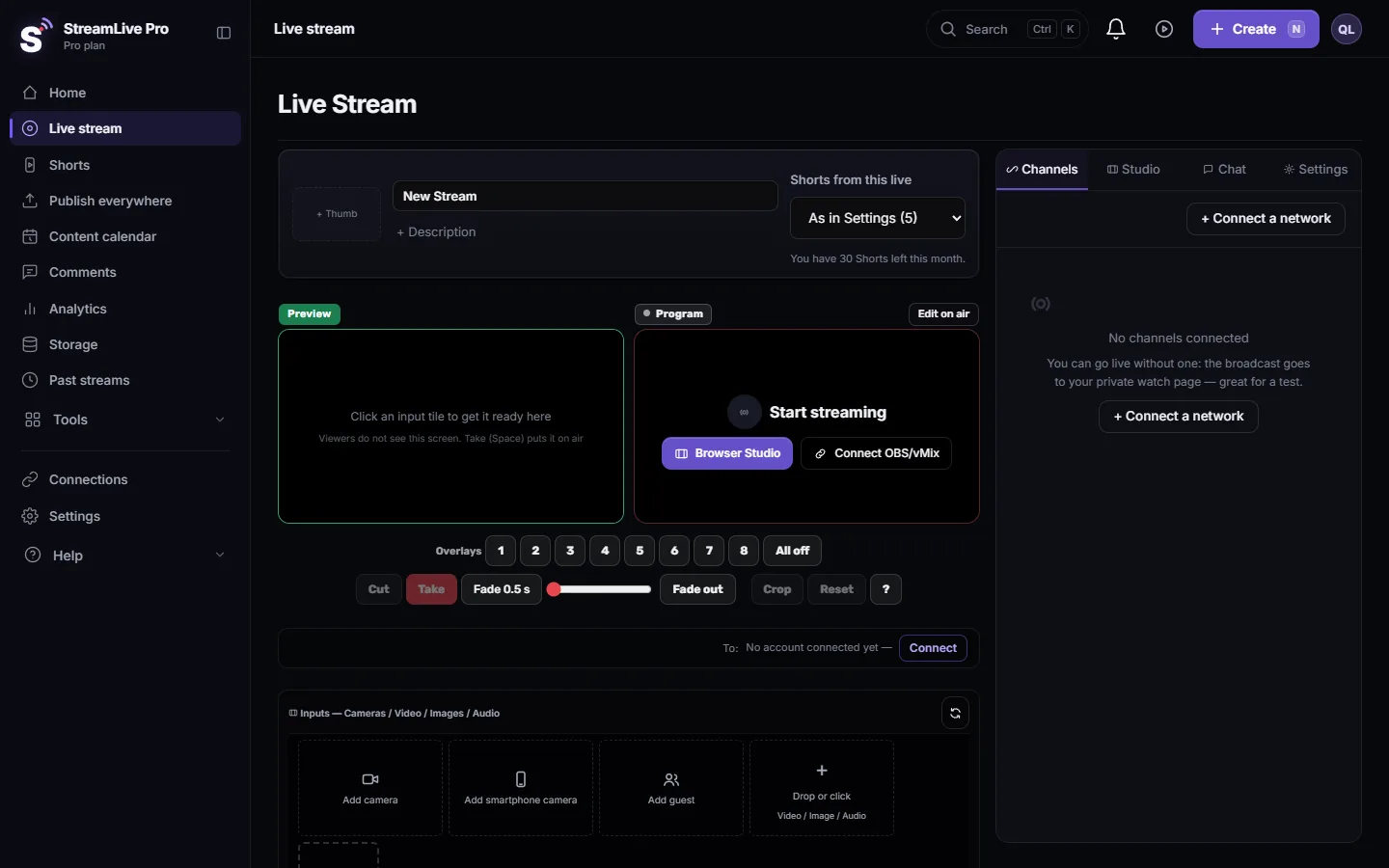
- The preview on the Live stream page is built in segments and typically trails your encoder by ten to thirty seconds. Judge your picture by the encoder and by the network, not by this preview.
- The networks add their own delay after that, as described above.
- Chat. Comments from YouTube and Facebook appear next to the player on the Live stream page (Live chat from YouTube and Facebook in one panel). A viewer's question refers to what they saw some seconds ago, so you are answering the recent past.
- Guests. People you bring into the browser studio with a guest link talk with you inside the studio itself, before the stream goes out to the networks, so a conversation with a guest does not carry the networks' delay between you (Guests and invitations — bringing people into the room).
Living with the delay
- Pause after questions to the audience. If you ask viewers something, wait a beat longer than feels natural before reading answers.
- Do not watch your own stream with sound on. The delayed audio will throw you off and can feed back into your microphone.
- Bring talk-back into the studio. For a real conversation, invite the person as a guest rather than talking through chat.
- Measure it once. Put a clock with seconds on screen, watch the live on a phone, and compare. Do it for each network you use.
- Start on time, then wait a moment. Viewers who open the live at the start see it some seconds later, so leave a short opening before the main point.
- Do not chase the lowest number. For a lecture or a service with little interaction, a normal delay with smooth playback serves viewers better.
Frequently asked questions
What is latency in live streaming?
The delay between something happening in front of the camera and viewers seeing it. A few seconds to half a minute is normal on social networks.
Why is my live stream behind real time?
Every step adds a little: encoding, upload, the relay, the network's processing, delivery in segments and the viewer's player reserve. The player reserve and the segments usually add the most.
Can I make my stream real-time on YouTube?
Not fully. YouTube's ultra-low latency setting brings most viewers under 5 seconds, and YouTube says it can increase buffering.
Does multistreaming add latency?
A relay adds one hop. Most of the delay comes from each network's processing and players, which happen with or without a relay.
Is SRT latency the same as stream latency?
No. SRT latency is a small buffer that gives lost packets time to be resent on the way to the server. Stream latency is the whole delay to the viewer.
Keep reading
Run a live Q&A: collect questions before, read YouTube and Facebook chat in one panel, show a question on screen, bring in an expert by link, and reuse the answers.
Run a webinar on YouTube and Facebook at onceHow to run a webinar live on YouTube and a Facebook Page at the same time: announcing it, slides and panelists, questions from both chats, and the replay.
How to live stream a bar mitzvah or a family eventLive stream a bar mitzvah, a brit or another family event for relatives who cannot come: privacy, cameras, sound, the hall's internet and a plan for the day.
What is VOD? The replay of a live streamWhat VOD means: video on demand, the recording people watch after a live ends. Where replays live on each network and in StreamLive Pro, and how to keep yours.
Want to try it? 7-day trial, no credit card.
Start free