 StreamLive Pro
How to share your screen in a live stream
How to share your screen in a live stream from the browser studio: pick a tab, window or whole screen, include its sound, and switch back to the camera.
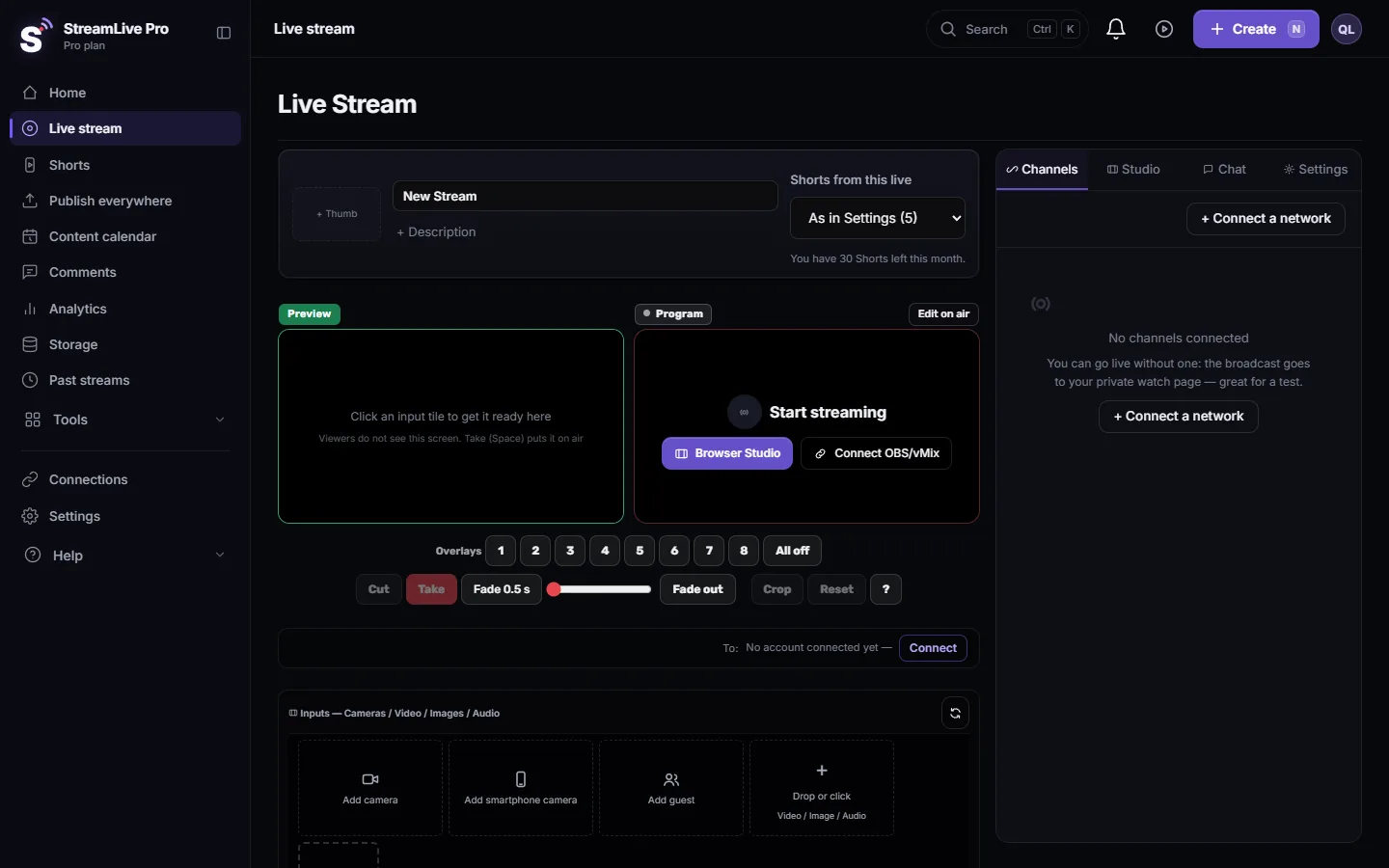
To share your screen in a live stream, open the browser studio, choose Add input, then Screen, and pick a tab, a window or the whole screen in the window your browser opens. The shared screen becomes the main picture of the broadcast and goes out to every network you selected. You stop it with the browser's own Stop sharing control. Nothing has to be installed.
Before you start
- A computer with Chrome or Edge, or Safari or Firefox. Screen sharing uses the browser's own screen picker, so what you can share (tab, window, whole screen) and whether sound comes along depends on the browser and the system. Mozilla's documentation says audio support varies by browser: developer.mozilla.org
- On a Mac, the browser needs permission to record the screen: Apple menu > System Settings > Privacy & Security > Screen & System Audio Recording, then switch on your browser. Apple's steps: support.apple.com . After switching it on, quit and reopen the browser.
- The studio must be running. If you press Screen before the studio starts, you get the message Start studio first.
- Any plan, including the trial. Screen sharing is part of the browser studio.
Steps
- Open the studio. Choose Live stream, start a new live and pick Browser Studio. Allow the camera and microphone when the browser asks.
- Prepare what you will show. Open the slides, the document or the browser tab before you share. If you plan to share one tab, it is the cleanest choice: viewers see only that tab, not your notifications or other windows.
- Open Add input. In the bar under the picture, open Add input (camera, screen, file, playlist) and press Screen.
- Pick the source. The browser's window opens. Choose a tab, a window or the entire screen. If the window offers to share the sound as well, switch it on when you want viewers to hear a video or audio that plays on the screen.
- Check the picture. The shared screen fills the main picture, and a Screen Share tile appears among your sources. Read a line of text on the preview: if it is hard to read there, it will be hard to read on a phone.
- Go live. Press Go Live as usual. You can also start sharing in the middle of a live; viewers see the change at once.
- Stop sharing. Use the browser's Stop sharing button (in the bar the browser shows, or in the tab). The studio says Screen share ended and returns to your camera.
Make it readable on a phone
Most viewers watch on a phone. Before the live:
- Enlarge the text: zoom the browser tab to 150 % or more, and use slide fonts of at least 28 points (a practical guideline, not a network rule).
- Close chats, mail and anything that can pop up. With a whole-screen share, every notification goes on air.
- Share a window or a tab rather than an ultra-wide monitor. A very wide screen gets small in a 16:9 frame.
- Keep the mouse still while you talk; a pointer that moves all the time is hard to follow.
Showing yourself and the screen together
Inputs you add in the studio (a camera, a logo, a title) are drawn above the main picture, so you can place a small camera input over the shared screen and be seen next to your slides. A green screen lets you stand in front of the slides themselves: How to set up a green screen virtual studio for live streams. With several cameras, see How to live stream with several cameras. Preview and Take, which let you prepare the next shot before viewers see it, are explained in Preview, Program, Take and Cut explained.
What can go wrong
- The picker shows nothing, or the shared screen is black (Mac). The browser has no screen recording permission. Switch it on in System Settings and reopen the browser. Full checklist: Screen sharing does not work on my Mac.
- Viewers do not hear the video you play. The sound option was not ticked in the browser's window, or the browser does not offer it for that kind of share. Share the tab that plays the video and tick the sound option.
- Echo when sharing a tab with sound. If the shared tab plays your own broadcast or a meeting, its sound goes back into the live. Mute that tab.
- The screen freezes after you switch tabs. The studio tab must stay open. If the picture stalls, come back to the studio tab; it reconnects the screen picture by itself.
- A guest wants to share a screen. In the live studio a guest has no screen-share button. Ask the guest to send the file or link and share it yourself, or use Video calls, where the host can give a guest permission to share: Guests and invitations — bringing people into the room.
Frequently asked questions
Can I share my screen without OBS?
Yes. The browser studio shares a tab, a window or the whole screen with nothing to install, and sends it to every network you selected.
Can viewers hear the sound of what I share?
Yes, when the browser offers sound for that share and you tick it in its window. Sharing a browser tab is the most reliable way to include sound.
Can a guest share their screen?
Not in the live studio: there a guest has no screen-share button, so the host shares. In Video calls the host can give a guest permission to share the screen.
Does screen sharing use more upload?
No. The studio still sends one stream from your computer, and our servers send it on to every network.
Can I share my screen from a phone?
The steps here are for a computer. On a phone, use the phone as a camera or join as a guest instead.
Keep reading
Go live from a Mac with nothing to install: the browser studio in Safari or Chrome, the macOS permissions to allow, and when an app is still better.
Resolution and frame rate for live streamingResolution and frame rate for live streaming in plain words: 720p or 1080p, 30 or 60 fps, how both drive bitrate, and how to set them in StreamLive Pro and OBS.
How to live stream a panel discussionHow to live stream a panel discussion with remote speakers: invites, layouts for three to five people, a moderator's run sheet, audience questions on screen, and Shorts.
How to live stream a cooking show with two camerasHow to live stream a cooking show with two cameras: a phone overhead on the pan, the cook's face, picture in picture, sound in a noisy kitchen, and Shorts of each recipe.
Want to try it? 7-day trial, no credit card.
Start free