 StreamLive Pro
What is multistreaming, and how does it work?
What is multistreaming: one live broadcast sent to several networks at once. How it works, why a cloud relay saves upload, what each network demands, and its limits.
Multistreaming means sending one live broadcast to several platforms at the same time: for example a lecture that is live on YouTube, on a Facebook Page and on LinkedIn at once, from one camera and one start button. It is also called simulcasting or restreaming. The point is reach: your audience is spread across networks, and multistreaming meets each part of it where it already is, without running a separate broadcast for each.
This page covers the term in depth. Shorter definitions of the related terms are in the Live streaming glossary: the terms you will meet.
How multistreaming works
A live broadcast starts at an encoder, the software or device that turns camera and microphone into a compressed stream: the Browser Studio, OBS, vMix, a phone, a hardware box. That stream has to reach each network's ingest server. There are two ways to get one stream to several of them.
From your own computer. The encoder sends a separate copy to each network. Some encoders do this with plugins or extra outputs. It needs no outside service, but every copy leaves your computer, so your upload carries the stream once per network.
Through a cloud relay. The encoder sends one stream to a relay service, and the relay's servers send a copy to each network. Your upload carries the stream once, whatever the number of networks. StreamLive Pro works this way.
The difference is plain arithmetic. For example, a 6 Mbps stream to three networks:
| Feature | Sent from your computer | Sent through a relay |
|---|---|---|
| Upload used | 3 x 6 = 18 Mbps | 6 Mbps |
| Encoding work on your computer | Once, or once per network, depending on the encoder | Once |
| Adding a fourth network | Another 6 Mbps of upload | No change to your upload |
| A drop on your line | Hits every network | Hits every network |
The last row matters: a relay does not protect you from your own connection. If your upload stalls, every network stalls together. Upload planning is in Upload speed and bitrate for multistreaming.
What each network asks of you
Multistreaming does not remove each network's own rules. Every destination still needs its own permission to go live, and some have conditions:
- YouTube needs live streaming enabled on the channel; the first time can take up to 24 hours.
- Facebook accepts a live on a Page you manage, not on a group or a personal profile.
- Instagram and TikTok give a stream key that works for one session, so a fresh key is pasted before every live. Who gets a key is decided by those networks (Live on Instagram and TikTok with a stream key).
- X keys also change between sessions.
- LinkedIn Live needs LinkedIn's approval first.
Each network also has its own limits on bitrate, resolution and keyframes. Since every destination receives the same stream, the settings you send must pass the strictest of them. For OBS, the settings that pass all of them are in OBS settings for multistreaming to several networks.
What multistreaming does not do
- It does not change the picture per network. Every destination receives the same picture. A landscape show stays landscape on TikTok; a vertical one stays vertical on YouTube. You choose one shape for the broadcast.
- It does not merge the audiences. Each network counts its own viewers, keeps its own replay and runs its own chat. Viewer numbers are reported by the networks that publish them.
- It does not make a weak line strong. A relay saves upload; it cannot add it.
- It does not replace each network's rights and rules. Content rules, music rights and age settings still apply on each platform separately.
Where it shows up in StreamLive Pro
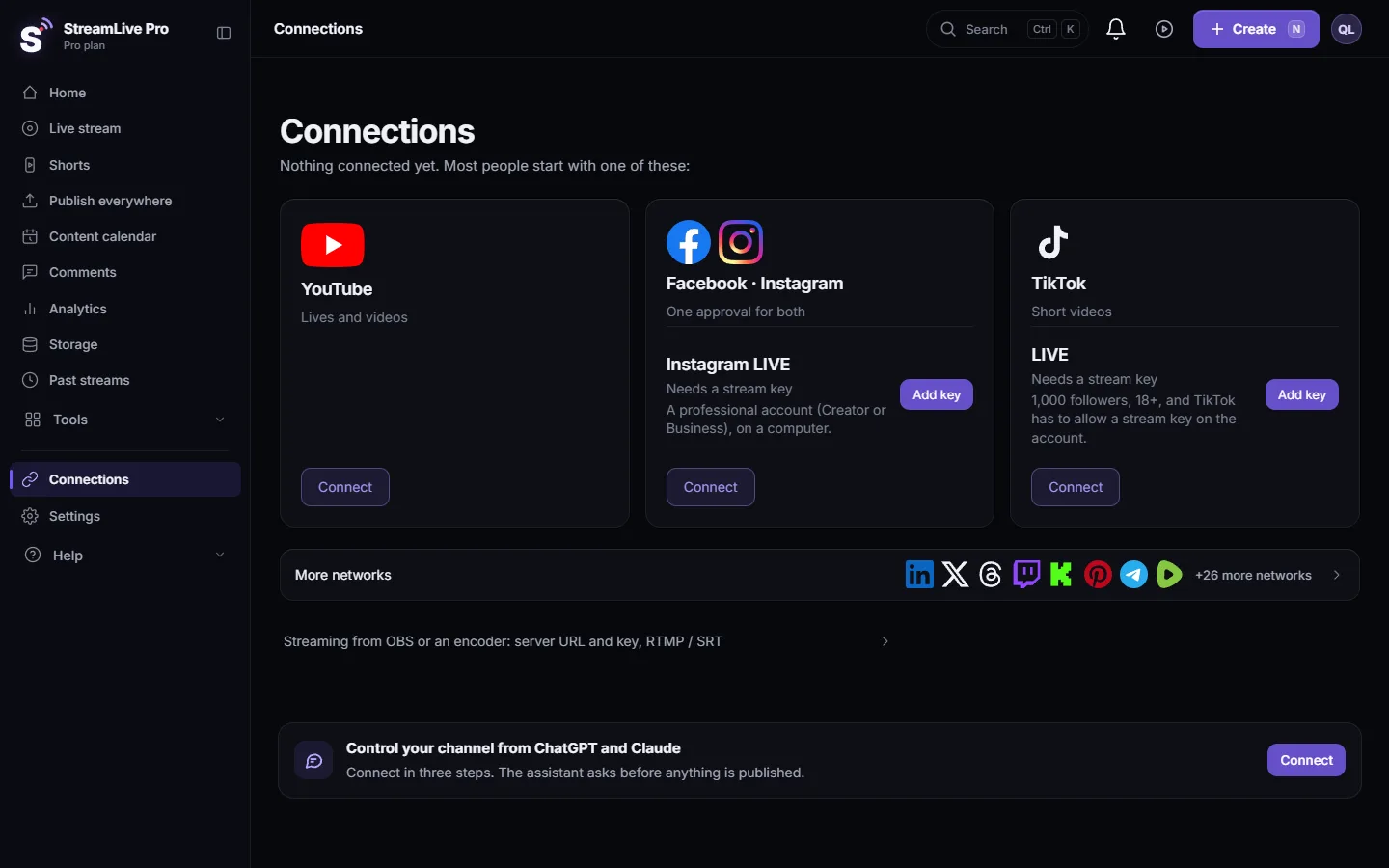
- Channels. You connect networks once under Connections, then tick the ones you want for each broadcast in the Channels list. The number of destinations you can use at once depends on your plan; the 7-day trial allows 2. See the pricing page.
- Sources. The browser studio, the phone, or an encoder such as OBS or vMix sending RTMP, RTMPS or SRT. Encoders are on the paid plans; the trial streams from the browser studio.
- Custom servers. Besides the built-in networks, you can add any server that accepts RTMP, RTMPS or SRT (Stream to a custom RTMP or SRT server).
- Chat. Comments from YouTube and Facebook appear in one panel next to the player, and you can reply to both (Live chat from YouTube and Facebook in one panel). Twitch and Kick chat shows there too, read only; other networks' chats are not read.
- One stop for all. Stop stream ends the broadcast on every network at once.
A worked example
For example, a weekly class goes live from the browser studio at 20:00. YouTube and a Facebook Page are connected once. Before each class, the host ticks both channels and presses go live. The host's computer uploads one stream; both networks receive it within seconds of each other. At the end, one press of Stop stream closes both, and each network keeps its own replay. If the class also needs Instagram, the host pastes a fresh Instagram key before that class, since it works for one session only.
Common misunderstandings
- "More networks need more upload." Only when the copies are made on your own computer. Through a relay the upload stays the same.
- "I need a plugin for each network." Not with a relay: you send one stream and choose the networks there.
- "Multistreaming means one chat." The chats stay separate on each network; a combined view is a feature of the tool, and it covers only the networks the tool can read.
- "Every network accepts the same thing." Most accept RTMP or RTMPS with H.264 video, but keys, approvals and limits differ, as listed above.
How tools that do this compare is in Restream vs StreamYard vs OBS: multistreaming tools in 2026. Step-by-step setup is in How to live stream to several platforms at once.
Frequently asked questions
What is multistreaming in simple words?
Sending one live broadcast to several platforms at the same time, such as YouTube, Facebook and LinkedIn, from one camera and one start button.
Is multistreaming the same as simulcasting or restreaming?
In everyday use, yes. All three describe one live broadcast going out to more than one platform at once.
Does multistreaming need more internet upload?
Only if your own computer sends a copy to each network. Through a cloud relay such as StreamLive Pro you upload the stream once, whatever the number of networks.
Can I multistream to Instagram and TikTok?
Yes, if the network has given your account a live stream key. Those keys work for one session, so you paste a fresh key before each live.
Does every network get the same picture?
Yes. Every destination receives the same stream, so choose one shape, landscape or vertical, for the whole broadcast.
Keep reading
Send a Microsoft Teams meeting to StreamLive Pro with the Custom Streaming app (RTMP-Out), then on to YouTube, a Facebook Page and more: admin setting and steps.
Stream a Webex meeting to YouTube and Facebook togetherSend a Webex meeting or webinar to StreamLive Pro with Webex's "Other streaming services" option, and from there to YouTube, a Facebook Page and more: fields and fixes.
Stream a Zoom meeting to YouTube and Facebook togetherSend a Zoom meeting or webinar to StreamLive Pro with Zoom's custom live streaming service, and from there to YouTube, a Facebook Page and more: fields and fixes.
How to multistream with OBS: a plugin or a relayMultistream from OBS to YouTube, Facebook and more: a multiple-RTMP plugin that uploads once per network, or one stream to a relay such as StreamLive Pro.
Want to try it? 7-day trial, no credit card.
Start free