 StreamLive Pro
What is an encoder in live streaming?
What is an encoder in live streaming: the software or device that compresses camera and sound into a stream. Software, hardware and browser encoders compared.
An encoder is the software or device that turns the picture of your cameras and the sound of your microphones into a compressed live stream and sends it to a server. Raw video from a single 1080p camera is far too large to send over a home connection, so the encoder compresses it with a codec, usually H.264 for video and AAC for sound, packs it, and pushes it over a protocol such as RTMP or SRT to an address with a stream key.
Every live stream has an encoder somewhere. The question is only whether it is a program you install, a box on your desk, or a web page. Shorter definitions of related terms are in the Live streaming glossary: the terms you will meet.
What an encoder does, in order
- Takes the sources. Cameras, microphones, screen capture, files.
- Mixes them into one picture and one sound, if the encoder is also a production tool (OBS, vMix, the browser studio).
- Compresses the picture and sound with a codec at the resolution, frame rate and bitrate you set. See What is a video codec? H.264, AAC and live streaming and What is bitrate in live streaming?.
- Packs and sends the stream to the ingest address of a server, over RTMP, RTMPS, SRT or WHIP. See What is an ingest server in live streaming?.
Kinds of encoders
| Kind | Examples | Strong points | Weak points |
|---|---|---|---|
| Software on a computer | OBS Studio, vMix, Streamlabs, Wirecast | Scenes, graphics, plugins, fine control | Uses the computer's processor or graphics card; you install and maintain it |
| Hardware encoder | ATEM Mini Pro, Blackmagic Web Presenter, YoloBox, Teradek | Runs on its own, few things to break, HDMI or SDI inputs | Fewer graphics, settings in a small menu, extra cost |
| Phone app | Larix Broadcaster, camera apps with RTMP | Always with you | Battery, heat and mobile data |
| Browser studio | StreamLive Pro Browser Studio | Nothing to install, works on most computers | Depends on the browser and the computer it runs on |
Software encoding and hardware encoding
Inside a software encoder there is a second choice with a confusing name: the video encoder. "Software" or "CPU" encoding (x264 in OBS) uses the computer's processor. "Hardware" encoding uses a dedicated part of the graphics card or chip: NVENC on NVIDIA cards, Quick Sync on Intel, and AMD's encoder on AMD cards. OBS names "QuickSync, NVENC or AMD VCE" as hardware encoders in its own guide (OBS Studio overview, checked 5 November 2026). Hardware encoding leaves the processor free for the rest of the show; processor encoding can give a slightly better picture at the same bitrate on a strong computer. For most talking shows hardware encoding is the safer pick on a laptop.
The encoder inside StreamLive Pro
When you choose Browser Studio in Live stream, the browser is the encoder. It captures the cameras and microphones you add, mixes the program, and compresses it with the browser's own video encoder, preferably H.264. The stream goes to StreamLive Pro, where the sound is set to AAC stereo at 48 kHz for the networks. When the browser already delivers H.264, our server passes the picture on as it is; otherwise it encodes it again on the server. Resolution, frame rate and bitrate are set in the studio's Stream Quality settings: Resolution and frame rate for live streaming.
When you choose Stream from software like OBS (RTMP / SRT), your own encoder does the work and StreamLive Pro receives its stream on the address and key shown on the encoder card. Guides: Connect OBS to StreamLive Pro and multistream, Connect vMix to StreamLive Pro and stream everywhere, Connect Streamlabs, Larix or a hardware encoder by RTMP, Stream from an ATEM Mini to several networks at once. Sending from an outside encoder is on the paid plans; the 7-day trial uses the browser studio: No stream key for OBS on the trial.
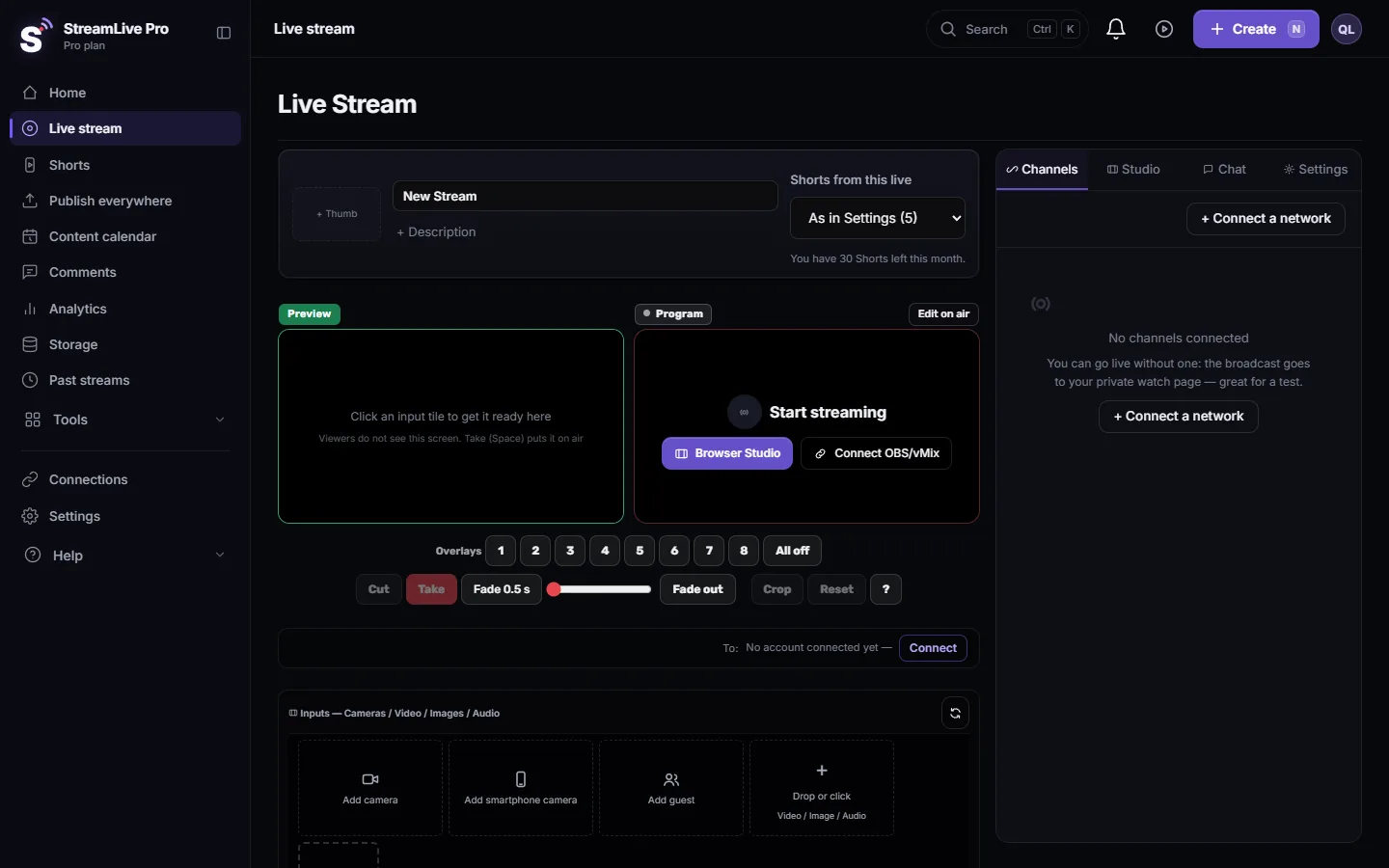
In both cases you send one stream, and StreamLive Pro makes the copies for each network on its servers. The encoder does not need to send a separate stream per network.
Encoder settings that matter most
Whatever encoder you use, the same handful of settings decides how the live looks and whether it holds up. The networks publish their own ranges; YouTube, for example, lists H.264 bitrates per resolution and frame rate and recommends a keyframe every 2 seconds (YouTube Help: live encoder settings, checked 5 November 2026).
| Setting | What it decides | A safe choice for a talking show |
|---|---|---|
| Resolution | How many pixels each frame has | 1080p, or 720p on a weak line |
| Frame rate | How many frames per second | 30 |
| Bitrate | How much data per second | Well below your measured upload |
| Rate control | Constant or variable bitrate | CBR (constant) |
| Keyframe interval | How often a full frame is sent | 2 seconds |
| Audio | Codec and sample rate | AAC, stereo |
With several networks, stay within the strictest of them. StreamLive Pro receives one stream and does not raise or lower these values for each network.
Which encoder to use
| Your situation | A sensible start |
|---|---|
| One camera, a microphone, slides | The browser studio |
| You already produce in OBS or vMix with scenes you like | Keep them and send to StreamLive Pro |
| A camera on HDMI or SDI, no computer at the venue | A hardware encoder |
| A weak laptop, a long show | Hardware video encoding in OBS, or the browser studio at 720p |
| Remote guests by link | The browser studio, which builds the guests' sound for you |
Common mistakes
- Too high a bitrate for the line. The encoder cannot send in time and drops frames: My live stream drops frames or keeps buffering.
- Keyframes too far apart. Networks ask for a keyframe every 2 seconds or so: What is a keyframe interval, and why set it to 2?.
- The key in the wrong field. The server address and the key go into separate fields: OBS says "Failed to connect to server.
- Two encoders sending to one key. Only one stream can arrive on a key at a time.
Frequently asked questions
What is an encoder in simple words?
The program or device that compresses your camera and microphone into a live stream and sends it to a server.
Do I need an encoder to go live with StreamLive Pro?
You need one, but it can be the browser. The Browser Studio encodes in the browser with nothing to install. OBS, vMix or a hardware encoder are optional.
What is the difference between a software and a hardware encoder?
Software runs on a computer and offers scenes and graphics. A hardware encoder is a dedicated box that runs on its own. Inside OBS, hardware encoding means using the graphics chip instead of the processor.
Does each network need its own encoder?
No. You send one stream to StreamLive Pro, and our servers send a copy to every network you ticked.
Which codec should my encoder use?
H.264 for video and AAC for sound. That is what the networks and StreamLive Pro's ingest accept.
Keep reading
A printable live stream checklist: test broadcasts, stream keys, sound check, backup internet, what to do if the stream drops, and the work after it ends.
PTZ cameras for live streaming: protocols and setupWhat a PTZ camera is, VISCA, Panasonic, ONVIF and NDI control, HDMI vs SDI vs NDI delay, presets for a lecture or service, zoom by room depth, PoE.
Upload speed and bitrate for multistreamingYouTube's bitrate table for 720p to 4K, the upload you need to multistream from OBS vs a relay, CBR and 2-second keyframes, and how to test your connection.
How to multistream: the complete guide to several networksHow to multistream to several platforms at once: your own keys from your computer, or one upload sent on by a server. Upload needs, network rules and pair guides.
Want to try it? 7-day trial, no credit card.
Start free