 StreamLive Pro
What is bitrate in live streaming?
What is bitrate in live streaming: how many bits per second your stream uses, how it differs from resolution and upload speed, CBR or VBR, and how to pick one.
Bitrate is the amount of data a stream uses every second, counted in bits: kilobits per second (kbps) or megabits per second (Mbps), where 1 Mbps is 1,000 kbps. In a live stream it decides two things at once: how much detail survives the compression, and how much of your internet upload the stream takes. A higher bitrate keeps more detail in moving pictures; it also needs a steadier, faster upload.
This page covers the term in depth. Shorter definitions of the related terms are in the Live streaming glossary: the terms you will meet.
Video bitrate, audio bitrate, total
A stream carries video and audio, each with its own bitrate. The video part is by far the larger: thousands of kbps against about a hundred for audio. YouTube, for example, lists 128 kbps for stereo audio (YouTube Help: live encoder settings). What your connection has to carry is the sum.
For example, 4,500 kbps of video plus 128 kbps of audio is 4,628 kbps, about 4.6 Mbps.
Bitrate is not resolution
Resolution is how many pixels each frame has (1280x720, 1920x1080). Frame rate is how many frames per second (30, 60). Bitrate is how many bits are spent describing all of them. The three work together:
- The same 1080p picture at a low bitrate looks blocky in fast motion, because there are not enough bits to describe every change.
- A talking head changes little from frame to frame, so it looks clean at a bitrate that would smear a football match.
- 60 frames per second needs more bitrate than 30 for the same look, because there are twice as many frames to describe.
This is why a steady 720p often looks better than a 1080p that is starved of bits or keeps stalling.
Bitrate and upload speed
Your upload speed is how much data your connection can send per second. Speed tests report it in Mbps, the same unit as bitrate. Two things to watch:
- Leave room. An upload that tests at the same number as your bitrate will not hold it during a whole show: other devices, background syncing and small dips all take a share. Keep your total bitrate well below the measured upload.
- Bits and bytes. Download managers often show MB/s, megabytes per second. One byte is 8 bits, so 1 MB/s is 8 Mbps. Do not compare MB/s with Mbps directly.
The arithmetic for a live with several networks is in Upload speed and bitrate for multistreaming.
Bitrate and file size
Bitrate also tells you how big a recording of the stream will be. Multiply the bitrate by the seconds, then divide by 8 to get bytes. For example, a 6 Mbps stream for one hour: 6 x 3,600 = 21,600 megabits, divided by 8 is 2,700 megabytes, about 2.7 GB. A two-hour class at 4.5 Mbps comes to about 4 GB. The same sum tells you how much data a stream uses on a mobile plan: an hour at 4 Mbps is about 1.8 GB of upload, so check your data allowance before you stream from a phone hotspot.
Constant or variable bitrate
| Feature | CBR (constant) | VBR (variable) |
|---|---|---|
| How it spends bits | About the same every second | More on busy scenes, less on calm ones |
| Effect on your upload | Flat and predictable | Spikes when the picture gets busy |
| Typical use | Live streaming | Recording and files for download |
For live, CBR is the usual choice. A variable bitrate spikes exactly when the scene is busiest, which is also when your line is most likely to be full. Cloudflare Stream, which receives encoder streams for StreamLive Pro, recommends CBR when possible (Cloudflare Stream: Start a live stream, checked 5 November 2026).
What goes wrong at each end
Too high for your line. The encoder cannot get the data out in time. OBS counts dropped frames, the browser studio's Stream health turns yellow or red, and viewers on every network see stutter or freezes. See My live stream drops frames or keeps buffering.
Too low for the picture. Nothing breaks, but fine detail turns into blocks when people move, text on slides blurs, and dark scenes look muddy.
Outside what the receiver accepts. Servers that receive streams set limits. Cloudflare Stream accepts a combined bitrate between 2 and 14 Mbps and recommends typically under 10 Mbps. A stream far outside that range can be refused or deliver no usable picture.
How to choose a bitrate
- Measure your upload with a speed test, on the connection you will actually use, at the time of day you will use it.
- Pick resolution and frame rate for the content. Speech and slides: 30 fps. Sport, music with movement: 60 fps if the bitrate allows.
- Check what your destinations ask for. YouTube publishes ranges per resolution and frame rate on its encoder settings page. Other networks publish their own; with several destinations, stay within the strictest.
- Stay well inside your upload and within the receiver's range.
- Test for twenty minutes before an important show and watch for dropped frames.
For OBS, these choices are turned into concrete settings in OBS settings for multistreaming to several networks. Hardware sometimes names bitrates for you: Blackmagic's ATEM Mini manual, for example, lists Streaming High as 6 to 9 Mb/s (Stream from an ATEM Mini to several networks at once).
Where bitrate shows up in StreamLive Pro
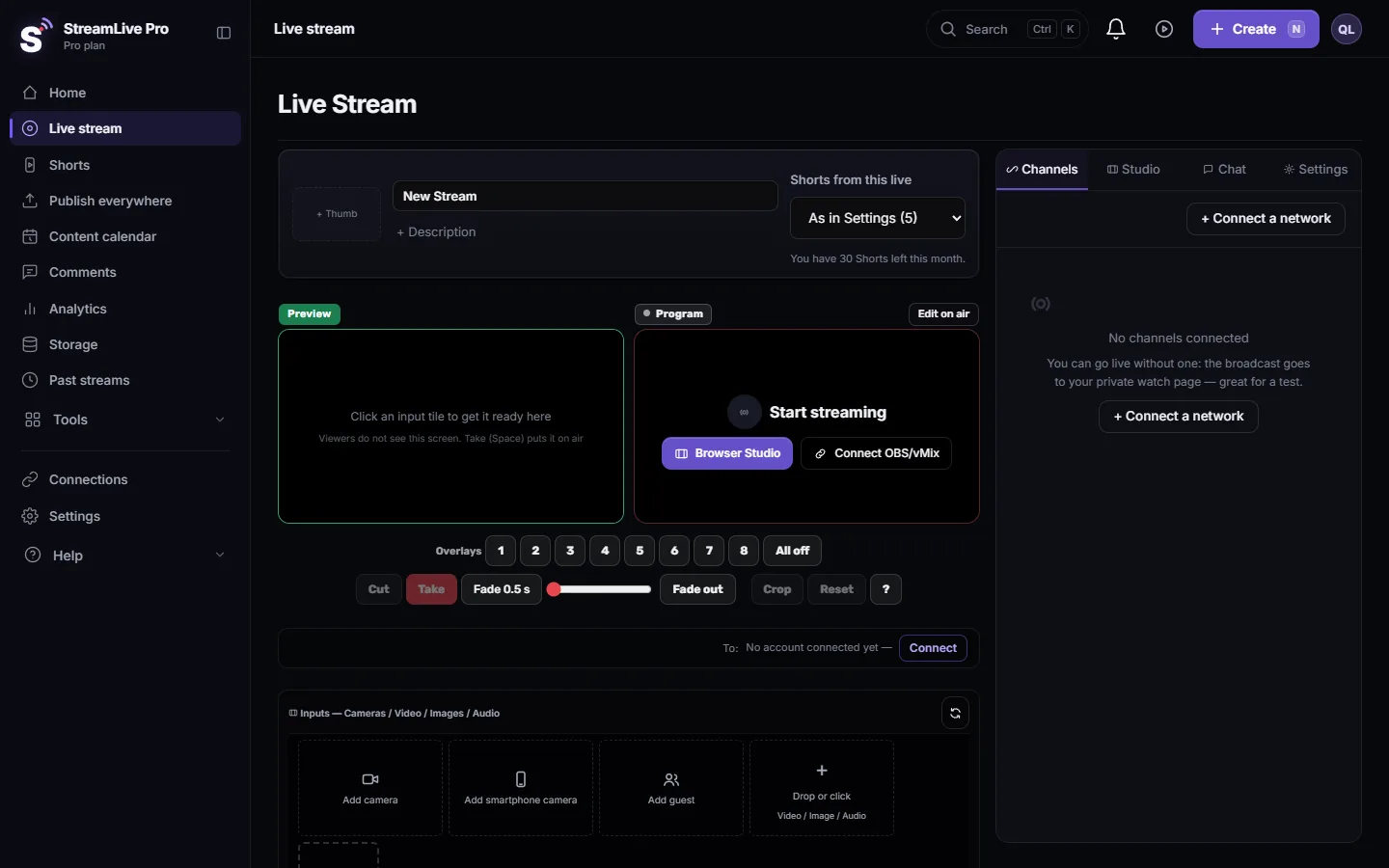
- Browser studio. On the Live stream page, the Settings tab has Stream Quality with Resolution, Frame Rate and Bitrate. Bitrate on Auto is the recommended choice: it starts at a rate that fits the resolution and steps down by itself on a poor network.
- Encoders. With OBS, vMix, an ATEM or FFmpeg, you set the bitrate in the encoder, and StreamLive Pro passes that stream on.
- Several networks. Your computer sends one stream to StreamLive Pro and our servers send the copies, so ticking more channels does not raise the bitrate you upload.
Frequently asked questions
What is bitrate in simple words?
How much data your stream uses each second. More bitrate keeps more detail, and needs more upload.
What is a good bitrate for streaming?
It depends on resolution, frame rate, content and your upload. Use the destination's published range, keep the total well below your measured upload, and stay within the receiver's limits.
Is a higher bitrate always better?
No. Above what your upload holds, a higher bitrate causes dropped frames and freezes, which look worse than a slightly softer picture.
Does streaming to more networks need a higher bitrate?
No. The bitrate is a property of the stream. Through StreamLive Pro you upload one stream whatever the number of networks.
What is the difference between Mbps and MB/s?
Mbps is megabits per second, MB/s is megabytes per second. One byte is 8 bits, so 1 MB/s equals 8 Mbps.
Keep reading
Stream a game to Twitch, Kick and YouTube at once: OBS sends one stream, StreamLive Pro sends it on, plus chat, upload, platform rules and Shorts of your best moments.
What is an ingest server in live streaming?What is an ingest server: the address your encoder sends a live stream to, with a stream key. How ingest differs from playback, what it checks, and where to find yours.
Connect PRISM Live Studio to StreamLive ProAdd StreamLive Pro as a custom channel in PRISM Live Studio on the computer and send one stream to YouTube, Facebook Pages, Twitch and more: steps, settings and fixes.
Connect XSplit Broadcaster to StreamLive ProAdd a Custom RTMP output in XSplit Broadcaster with StreamLive Pro's address and key, and reach YouTube, Facebook Pages, Twitch and more from one stream: steps and fixes.
Want to try it? 7-day trial, no credit card.
Start free