 StreamLive Pro
Connect Streamlabs, Larix or a hardware encoder by RTMP
Connect Streamlabs, a phone encoder app like Larix, or a hardware encoder to StreamLive Pro by RTMP: split or combined address, settings, and fixes.
Any encoder that can stream to a custom RTMP server can feed StreamLive Pro: Streamlabs Desktop, a phone encoder app such as Larix Broadcaster, a hardware encoder box, or a video switcher with a built-in streaming output. They all need the same two things from the Encoder card, a server address and a stream key, and they differ only in how they ask for them. For OBS and vMix there are dedicated pages: Connect OBS to StreamLive Pro and multistream and Connect vMix to StreamLive Pro and stream everywhere.
Before you start
- A paid plan. Encoder ingest is on the paid plans. In the 7-day trial the Encoder card shows "On paid plans" instead of an address, and the trial streams from the Browser Studio. See the pricing page.
- H.264 video and AAC audio. StreamLive Pro receives encoder streams through Cloudflare Stream, which accepts these codecs only, a combined bitrate between 2 and 14 Mbps, and a keyframe interval between 2 and 10 seconds (Cloudflare Stream: Start a live stream, checked 5 November 2026). Most encoders default to H.264 and AAC; check devices that also offer HEVC.
- Channels connected under Connections.
Two ways an encoder asks for the address
| The encoder has | What you enter |
|---|---|
| Two fields: "Server" or "URL", and "Stream key" or "Stream name" | The address from the card in the first field, the key in the second |
| One field: "URL" or "RTMP URL" | The address and the key joined: the address ends with /live/, so paste the key right after it, with no space and no extra slash |
For example, an RTMPS address ending in /live/ and a key abc123 become one address ending in /live/abc123. Our own server joins them the same way when it plays a pre-recorded video into a broadcast.
Steps
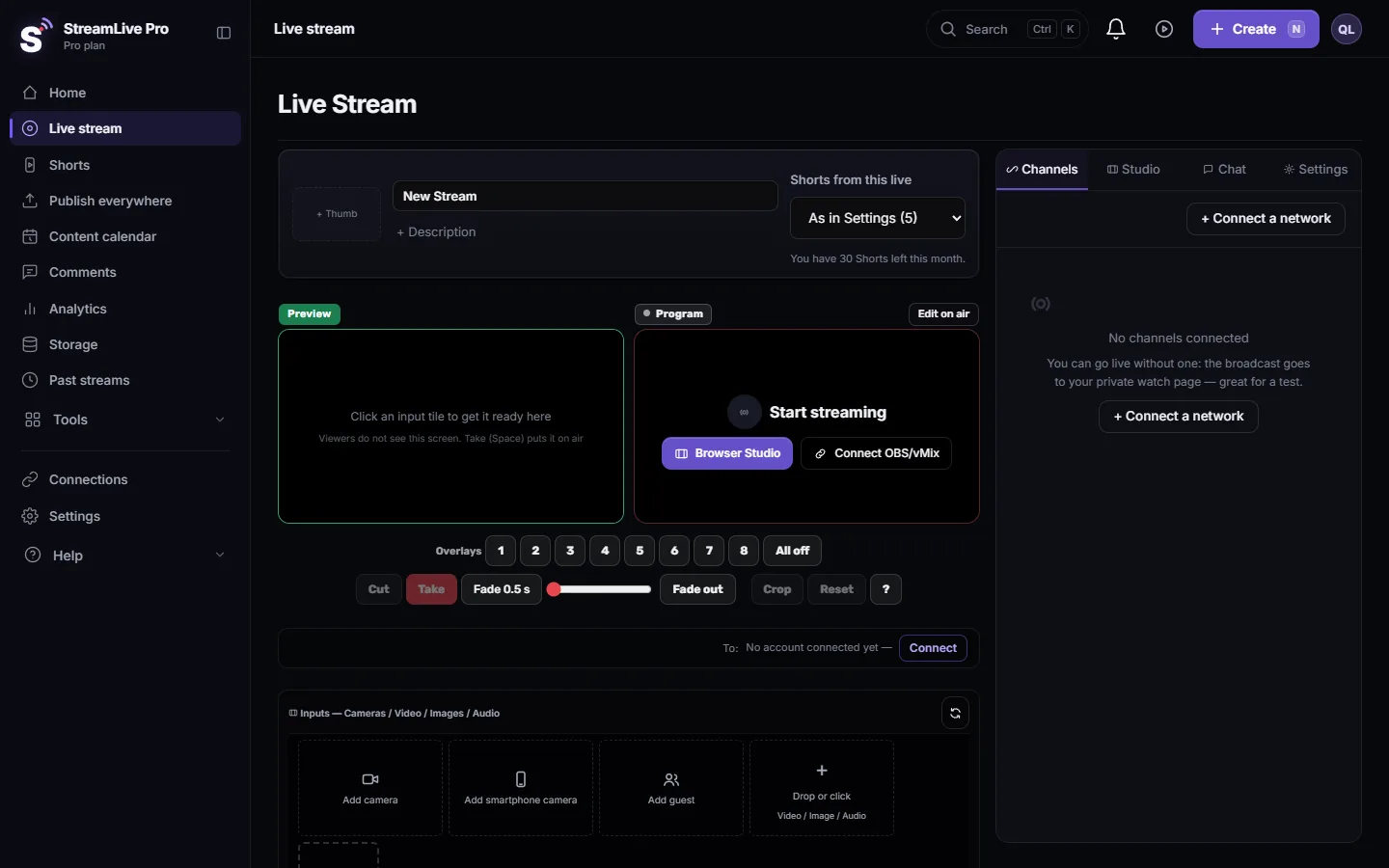
- Open the encoder panel. Click New stream at the top of the dashboard and choose Stream from software like OBS (RTMP / SRT). The Live stream page opens with the Encoder card.
- Choose RTMPS if the encoder supports it, RTMP if not. RTMPS is encrypted and runs on port 443. Some older hardware and some apps support RTMP only; then use the RTMP tab.
- Copy the address and the key with the copy buttons. If the encoder is configured on a phone or a device screen, type carefully: one wrong character in the key and the stream is refused.
- Enter them in the encoder. Split or joined, as in the table above. In Streamlabs Desktop, choose the custom streaming server option in the stream settings. In a phone encoder app, add a new connection and paste the joined address.
- Set the video. H.264, constant bitrate (CBR) if the encoder offers it, keyframe interval 2 seconds, AAC audio. Bitrate and resolution as in OBS settings for multistreaming to several networks; the same reasoning applies to every encoder.
- Tick your channels in the Channels list in StreamLive Pro, and keep that page open and visible.
- Start the encoder. Within about ten to thirty seconds StreamLive Pro shows that the stream was detected and sends it to the ticked channels.
- End from StreamLive Pro. Press Stop stream to end on every network, then stop the encoder. If you only stop the encoder, StreamLive Pro first waits a few minutes (by default) for the signal to come back, and only then ends the broadcast, so the networks stay live with no picture meanwhile.
Notes per kind of encoder
- Streamlabs Desktop. Use the same values as in OBS settings for multistreaming to several networks. Send one stream to StreamLive Pro and leave the copies to each network to our servers, rather than adding destinations inside Streamlabs as well.
- Phone encoder apps. Useful when you want a phone's camera with manual control and a wired or bonded connection. If you only need a phone as a camera, StreamLive Pro's own phone camera link needs no app: see Use your phone as an extra camera.
- Hardware encoders and switchers. Some take the address in a web page or a settings file rather than on the device. Many cannot paste, so check the key twice. If a device offers SRT, see Stream with SRT from OBS, vMix or a hardware encoder.
- Cameras that only give an rtsp:// address. RTSP is pulled, not pushed, so it cannot go straight to us. Something in between (OBS, vMix, an encoder box) has to pull it and push RTMP; RTMP and stream keys: where to find them, what breaks explains the difference.
What can go wrong
| Symptom | Fix |
|---|---|
| "Connection failed" with a joined address | A doubled slash, a space, or a missing /live/ part. Join the address and key again exactly. |
| Works at home, not at the venue | Port 1935 is blocked there. Use RTMPS (port 443) if the device supports it. |
| Connected, no picture | HEVC selected, or a keyframe interval above 10 seconds. Use H.264 and 2 seconds. |
| Device says live, StreamLive Pro does not | The key is from an earlier broadcast. Copy the key from the card you have open now. |
| Stutters on every network | The bitrate is above what the line holds. Lower it. |
More checks are in My encoder says it is streaming, but there is no picture.
Frequently asked questions
Can I use Streamlabs with StreamLive Pro?
Yes, on a paid plan. Choose the custom streaming server option in Streamlabs, paste the address and key from the Encoder card, and send one stream. Our servers send it to every network you ticked.
My encoder has only one URL field. What do I enter?
The address and the key joined together: the address ends with /live/, and the key goes right after it, with no space and no extra slash.
Does my hardware encoder need RTMPS?
No. RTMPS is preferred because it is encrypted and runs on port 443, but RTMP works too. Use RTMP if the device does not support RTMPS.
Can I connect an IP camera directly?
Only if the camera can push RTMP or SRT to a custom server. A camera that only offers an rtsp:// address needs OBS, vMix or an encoder in between.
Can I use an encoder during the trial?
No. Encoders are on the paid plans; the 7-day trial streams from the browser studio.
Keep reading
Stream a game to Twitch, Kick and YouTube at once: OBS sends one stream, StreamLive Pro sends it on, plus chat, upload, platform rules and Shorts of your best moments.
What is an ingest server in live streaming?What is an ingest server: the address your encoder sends a live stream to, with a stream key. How ingest differs from playback, what it checks, and where to find yours.
Connect PRISM Live Studio to StreamLive ProAdd StreamLive Pro as a custom channel in PRISM Live Studio on the computer and send one stream to YouTube, Facebook Pages, Twitch and more: steps, settings and fixes.
Connect XSplit Broadcaster to StreamLive ProAdd a Custom RTMP output in XSplit Broadcaster with StreamLive Pro's address and key, and reach YouTube, Facebook Pages, Twitch and more from one stream: steps and fixes.
Want to try it? 7-day trial, no credit card.
Start free