 StreamLive Pro
Persistent and one-time stream keys, network by network
A persistent stream key stays the same between broadcasts; a one-time key works for one live. Which networks use which, from their own help pages, and what to paste when.
A stream key is the secret string that tells a network which channel an incoming stream belongs to. Some networks give you a key that stays the same from one broadcast to the next, so you paste it once. Others hand out a new key for every live or every event, so yesterday's key opens nothing today. Knowing which kind each network uses is most of what stops a broadcast from starting toward a dead key.
For the basics of server URLs, keys and protocols, read RTMP and stream keys: where to find them, what breaks. This page goes one level deeper: the kinds of key, and what each network does, checked on the networks' own pages on 5 November 2026.
The terms
Persistent stream key
A key that stays valid across broadcasts until you reset it. You paste it into your encoder or into StreamLive Pro once. Good for a weekly show. The risk: if it leaks, it keeps working for whoever has it until you reset it.
One-time (per-session) key
A key that is issued for one live session. When the session ends, the key is spent. You copy a new one before every broadcast. Safer, one more step.
Per-event key
A key that belongs to one scheduled event on the network. Each new event has its own key. Close to one-time, but you can copy it as soon as the event exists, ahead of the broadcast.
Recurring event or source
Some networks let you create an object that is reused (a recurring event, a source, a persistent stream). Its key stays with it, so it behaves like a persistent key.
Token
Some networks call the key a token (Steam does). Same job, same rules: keep it private.
Sign-in connection
Not a key at all for you. You sign in to the network once, and the service asks the network for the current key, or creates the broadcast itself, at the start of each live.
Network by network
| Network | Kind of key | Source |
|---|---|---|
| YouTube | Persistent default key in YouTube Studio; reset when needed | YouTube Help: Create a live stream with an encoder |
| Twitch | One key per channel, stays until reset | Twitch Help: Stream key FAQ |
| Kick | Stays until reset; after a reset, update your software | Kick Help: How to stream on KICK.com |
| Refreshes each time you use Live Producer | Instagram: Live Producer | |
| VK Video | Your choice: one-time or persistent | VK for authors: broadcasting from a computer |
| Odysee | Server and key carry over to your next streams | Odysee Help: Reusing the stream server and key |
| Steam | Token valid until you invalidate it and create a new one | Steamworks: Setting up a stream |
| One key per LinkedIn Live event | LinkedIn Help: LinkedIn Live overview |
For TikTok, StreamLive Pro's own key window says the key changes on every new live session; TikTok decides which accounts get a key at all (TikTok LIVE Safety Guide). For Vimeo, the Vimeo Live card in StreamLive Pro says a recurring event keeps its key and a one-time event has its own. For X, the X card says a source created in Media Studio Producer keeps the same URL and key (X Help: Media Studio Producer explains sources). For Bilibili and Huya, StreamLive Pro's cards treat the key as new for every start. We did not find these rules stated on the networks' own help pages, so check them on the network.
How StreamLive Pro treats each kind
StreamLive Pro knows, per network card, which kind of key to expect, and the go-live step follows from that.
| Kind | What you do | What StreamLive Pro does |
|---|---|---|
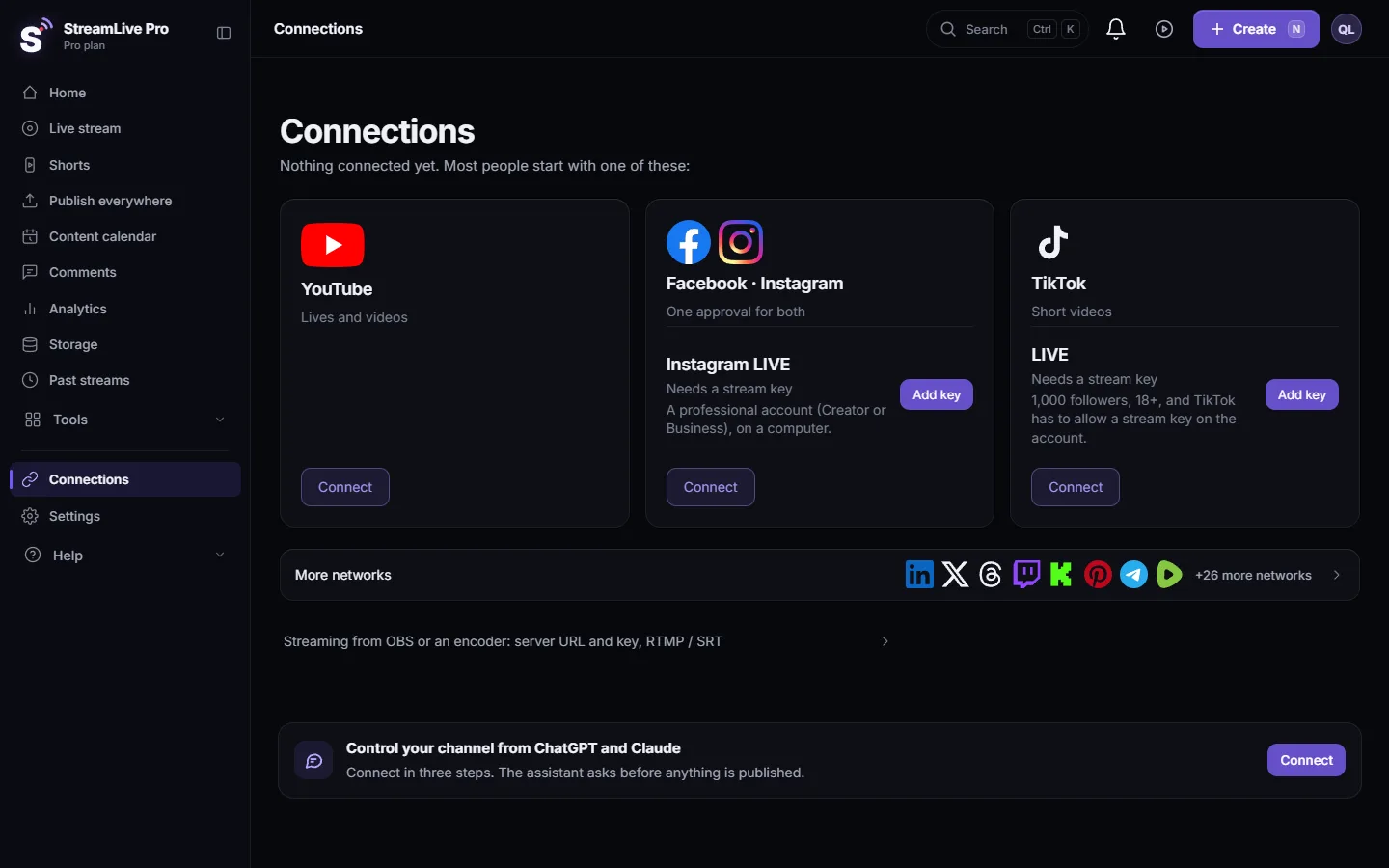
| Sign-in (YouTube, Facebook Pages, Twitch, Kick) | Connect once on Connections | Creates the broadcast or fetches the current key at every start |
| Persistent (for example Trovo, Odysee, Steam) | Paste once | Uses the saved key every time |
| Often reused (X) | Paste once | At go-live shows Same key, with an I have a new key button |
| New each time (Instagram, TikTok, LinkedIn) | Paste before every live | The channel says "Ready. We ask for a new key when you go live", and the key step asks for it in one place |
A few details that help:
- One box takes both. In the key window you can paste the server URL and the key together, in any order, on one line or two, or the full address with the key glued on the end. StreamLive Pro splits them.
- Key on your phone. Instagram and TikTok often show the key on a phone. The key window has a link that shows a QR code; paste the key on the phone and it lands in the computer's window. The link lasts 10 minutes and is used once.
- Wrong address, named. Each card checks that the address belongs to its network. If you paste a Twitch address into the Trovo card, the message says it is a Twitch address.
- Old keys flagged. A per-session key from the last broadcast is marked as needing a new key, so you do not start toward a dead key.
- Stored encrypted. Saved keys are encrypted and shown masked, never again in full.
Common mistakes
- Saving a one-time key as if it were persistent. It works once, then the network shows nothing next time. Paste a fresh one each time for Instagram, TikTok and LinkedIn.
- Resetting a persistent key and forgetting the copies. After a reset on Twitch, Kick or YouTube, every encoder and card that held the old key needs the new one.
- Showing the key on screen. A persistent key that appears in a recorded tutorial keeps working for whoever saw it. Reset it.
- Pasting the key into the server field, or a space at the end. The cards refuse a key field that holds a URL or spaces, but a trailing space in other software can fail silently.
- Using a key from another channel. If the Google or Kick account has several channels, check which one you copied from.
Choosing, where you have a choice
On VK you choose between one-time and persistent; on Vimeo between a recurring and a one-time event. A persistent key saves a step for regular shows with the same title. A one-time key is the safer choice when several people handle the encoder, or when each broadcast needs its own title.
Going further
Network guides: How to go live on X (Twitter) from your computer, How to go live on VK Video from your computer, How to go live on Instagram from a computer, How to go live on LinkedIn with a custom stream. When a key does not work: My Instagram or TikTok stream key does not work. All networks: Going live on each network: what it needs.
Frequently asked questions
What is a persistent stream key?
A key that stays the same between broadcasts until you reset it. You paste it into your encoder or StreamLive Pro once and reuse it every time.
Which networks change the stream key every live?
Instagram says its key refreshes each time you use Live Producer, and every LinkedIn Live event has its own key. StreamLive Pro also treats TikTok keys as new for every session.
Does my YouTube stream key change?
The default key in YouTube Studio stays the same until you reset it. With the YouTube sign-in in StreamLive Pro you do not handle a key at all.
Is a persistent key less safe?
It is more exposed: if it leaks, it keeps working until you reset it. Keep it private and reset it if it may have been seen.
Do I need keys for Twitch and Kick in StreamLive Pro?
No, if you connect them with a sign-in. StreamLive Pro fetches the current key from each network at the start of every broadcast.
Keep reading
A live streaming glossary in plain words: stream key, RTMP, SRT, bitrate, multistream, Preview and Program, ISO, captions, reframe. Where each shows up in StreamLive Pro.
How to stream on Bilibili Live with a stream keyStream on Bilibili Live from your browser: start a live in your Bilibili room, copy the server and fresh key into the Bilibili Live card, then go live.
How to go live on Dailymotion with a stream keyGo live on Dailymotion: get live enabled on your account, create a live stream in Dailymotion Studio, and paste its stream URL and key into StreamLive Pro.
How to stream on DLive with your stream keyStream on DLive from your browser: copy the key from your DLive dashboard, paste it into the DLive card in StreamLive Pro, and go live alone or with other networks.
Want to try it? 7-day trial, no credit card.
Start free