 StreamLive Pro
Chroma key and luma key: what they are and when to use them
Chroma key removes one colour, such as a green screen. Luma key removes the darkest or brightest parts. How each works, when to use which, and where to find them.
A key makes part of a picture transparent so that something else shows through. A chroma key decides what to remove by colour: everything close to a chosen green or blue disappears, which is how a green screen works. A luma key decides by brightness: everything darker than a threshold (or brighter, depending on the tool) disappears, which is how a logo on a black background loses its black box. Both are used in live production every day, and both are in the StreamLive Pro browser studio.
Shorter definitions of related terms are in the Live streaming glossary: the terms you will meet.
Chroma key and luma key side by side
| Chroma key | Luma key | |
|---|---|---|
| Removes by | Colour (hue) | Brightness (luminance) |
| Typical source | A person in front of a green or blue screen | A logo, a title or an effect on a black background |
| What you set | The key colour, often with an eyedropper, and a threshold | A brightness threshold |
| Fails when | The person wears the key colour, the screen is lit unevenly | The subject has dark parts that should stay |
| Also called | Green screen, blue screen, colour key | Luminance key |
How a chroma key works
The software looks at every pixel and asks how close its colour is to the key colour. Close enough, it becomes transparent; far away, it stays; in between, at the edges, it becomes partly transparent so hair and outlines blend in. Green is the usual choice because cameras capture it with the least noise and it is far from skin tones. Blue is used when someone wears green or there are plants in the shot.
Most problems are in the room, not in the software: wrinkles and shadows on the screen make patches of different green, and a person standing close to the screen picks up a green glow on the shoulders. The full room setup is in How to set up a green screen virtual studio for live streams.
Setting a clean chroma key, step by step
- Light the screen first. Two soft lights on the screen, aimed so it looks evenly bright from one side to the other, with no hot spot in the middle.
- Separate the person. Move them a metre or more from the screen, so no green bounces onto their shoulders, and light them on their own.
- Lock the camera. Set exposure and white balance by hand, so the green does not shift during the show.
- Turn on the key. In the camera's settings switch on Colour key and pick the colour with the eyedropper from the middle of the screen.
- Raise the threshold slowly. Stop when the background is gone; going further starts to eat into hair and edges.
- Check on Program. Look at the result on the program picture, with the new background behind it, before you go live.
How a luma key works
The software computes the brightness of every pixel. Pixels below the threshold become transparent, pixels above it stay, and a narrow soft zone around the threshold keeps the edges smooth. Raise the threshold and more of the dark parts disappear; lower it and more stay.
A luma key is the quick fix for graphics delivered on black: an animated logo, a lower third exported without transparency, smoke or light effects. It is the wrong tool for a person, because a dark jacket or dark hair would disappear with the background.
Where they are in StreamLive Pro
Chroma key in the browser studio. Open the camera's settings (the gear on the camera) and turn on Colour key. Choose green or blue, or pick the exact colour with the eyedropper, then adjust the threshold until the edges are clean. In the Podcast studio the colour can be detected automatically, and you can choose a background image for each camera.
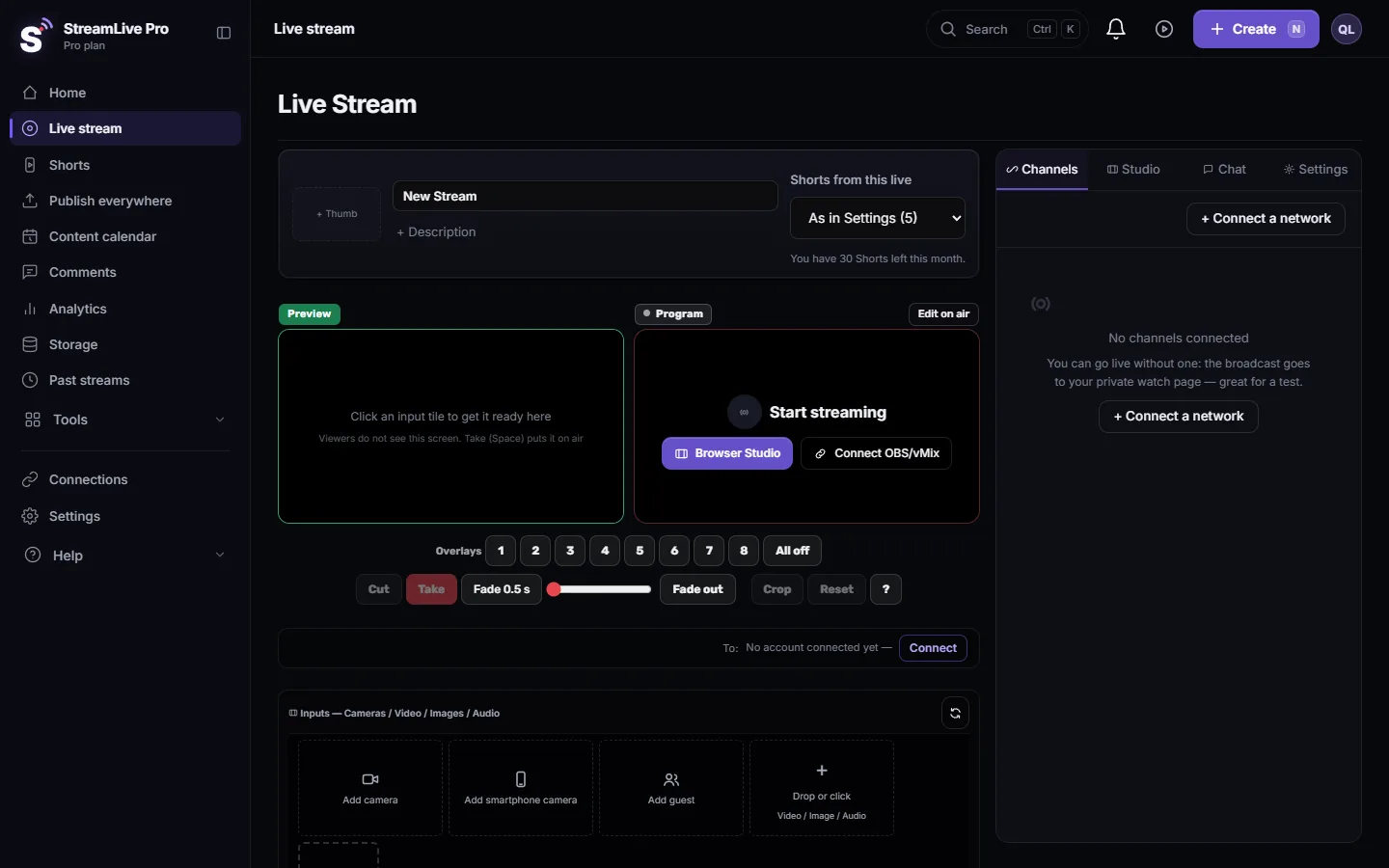
Luma key in the browser studio. An input such as an image or a video file has a luma key slider in its settings. Parts darker than the slider become transparent on Program, on overlays and in layers. The input keeps its own colour key, position and transparency alongside it. Overlays in general: Add a logo and overlays to your live stream and Overlay channels 1 to 8 and their keys (F1 to F8).
Chroma key in the video editor. For recordings and uploads, the Video editor has its own chroma key: Green screen (chroma key) in the video editor.
No screen at all. If you have no green screen, the studio can blur or replace the background around a person without a key colour: Virtual background and background blur in a live. It is quicker to set up, and edges are less precise than a well-lit green screen.
Choosing the right key
| What you have | Use |
|---|---|
| A person in front of a green or blue screen | Chroma key |
| A logo or animation on a black background | Luma key |
| A logo or animation on a green background | Chroma key |
| A PNG image with real transparency | No key needed; it is already transparent |
| A person in a normal room, no screen | Virtual background or blur |
Whenever you can, ask for graphics with real transparency (PNG for still images). A key is a repair; real transparency has no edges to clean.
Common mistakes
- Clothes in the key colour. A green tie disappears with the screen. Change the shirt or switch to blue.
- Uneven light on the screen. The key catches one shade and leaves another. Light the screen evenly and separately from the person.
- The camera adjusting itself. Automatic exposure and white balance change the green during the show, and the key flickers. Lock them on the camera.
- A luma threshold set too high. Dark parts of the logo vanish along with the background. Lower it until the logo is whole.
- Keying a heavily compressed source. Blocky video gives blocky edges. Use the cleanest source you have.
Frequently asked questions
What is the difference between chroma key and luma key?
Chroma key removes a colour, such as a green screen. Luma key removes by brightness, usually the black around a logo or effect.
Do I need a green screen to change my background in StreamLive Pro?
No. Virtual background and blur work without a screen. A green screen with a chroma key gives cleaner edges.
When should I use a luma key?
For graphics on a black background: logos, titles and light effects. Not for people, whose dark clothes or hair would disappear.
Green or blue screen?
Green in most cases. Blue when someone wears green or there are plants in the frame.
Can I key a logo that already has transparency?
There is no need. A PNG with transparency shows only the logo. Keys are for sources with a solid background.
Keep reading
Echo cancellation removes your speakers from your microphone; noise suppression removes background sound. What each does, its limits, and the StreamLive Pro settings.
What is ISO recording? Each camera in its own fileISO recording saves every camera to its own file, next to the switched program. Why editors want it, what it costs in disk space, and where StreamLive Pro offers it.
What is a lower third? Name titles in video, explainedA lower third is the name and title shown at the bottom of the screen when someone speaks. What it contains, how long to show it, Hebrew pitfalls, and how to add one.
Where is my live stream recording?Where is my live stream recording? Check Past streams and Storage, keep the video within about two hours, and learn why some broadcasts have none.
Want to try it? 7-day trial, no credit card.
Start free