 StreamLive Pro
Input settings in the browser studio, tab by tab
Each input in the browser studio has a settings window: crop, zoom, rotate, colour key, layers and camera controls. How to open it and what every tab does.
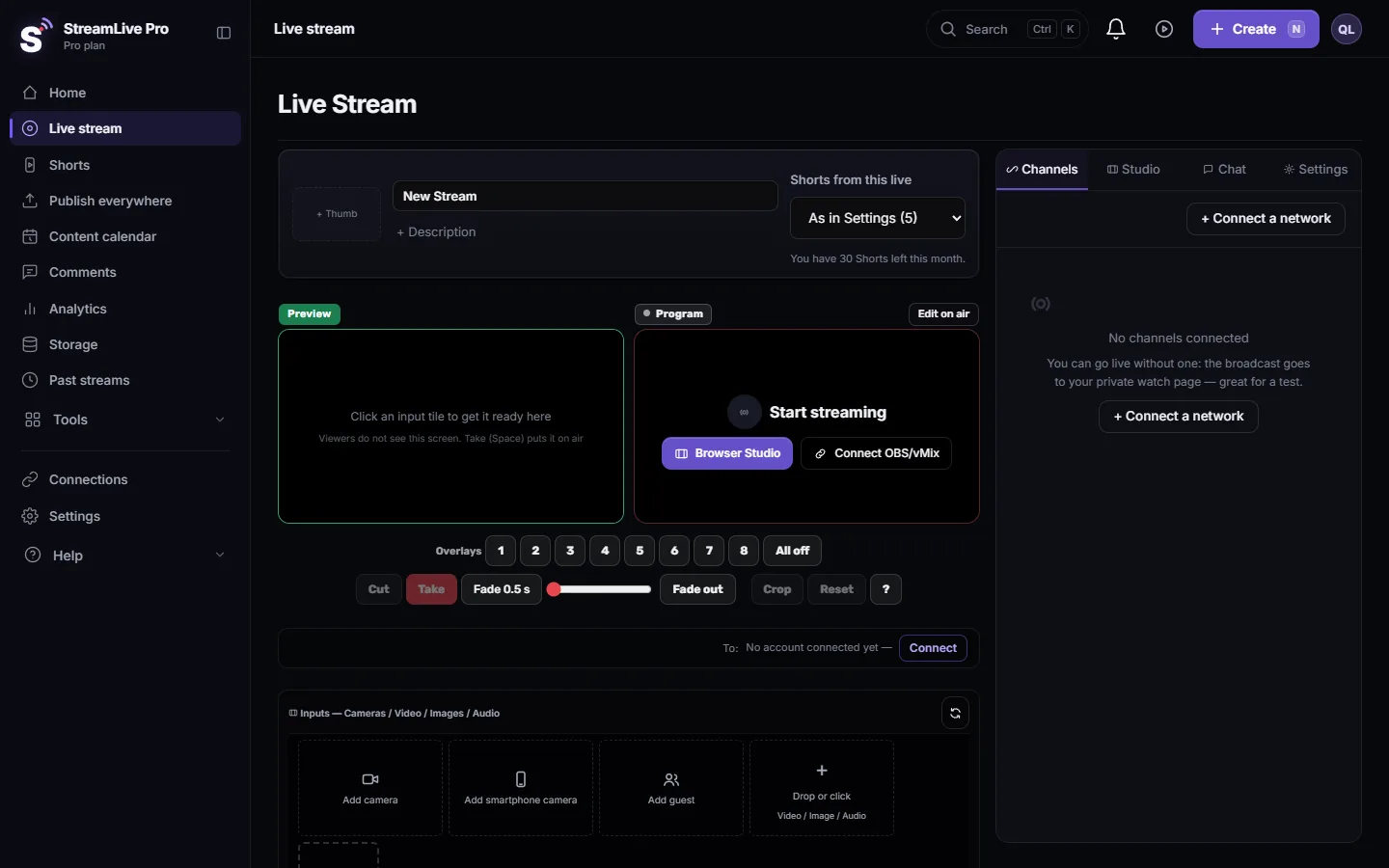
Every input in the browser studio, whether a camera, a picture, a video, a screen share or a guest, has its own settings window. Open it with the gear on the input's tile, or double-click the tile. The window has tabs for the look of the picture, the colour key, the position and crop, layers inside the input and, for cameras, the camera's own controls. Changes show at once on Preview, Done keeps them, and Cancel puts everything back as it was when you opened the window.
Open the window
- Open a studio. Live stream and then Browser Studio, or Podcast. The same window serves both studios.
- Find the input's tile in the inputs strip.
- Click the gear on the tile, or double-click the tile. A double-click opens the settings and never puts the input on air. The window's header shows the input's number, name, type and, for cameras and videos, the real picture size, for example 1280x720.
- Change what you need. Preview follows every change.
- Click Done, or Cancel. Done keeps the changes and shows "Settings saved". Cancel restores what was there when you opened the window.
The tabs
| Tab | Shown for | What it holds |
|---|---|---|
| Guest | Remote guests | The guest's display name and subtitle for a lower third, the on-air layout, and Push live to layer (1 to 6) |
| General | Every input | Name, the look of the picture, background, playback for videos, size and opacity for a logo |
| Colour Key | Every picture input | Green or blue screen removal and the luma key |
| Position | Every picture input | Zoom, pan, rotate and crop, with a preview |
| Layers | Every picture input | Up to 10 layers inside this input, and where the input's own picture sits among them |
| Camera Pro | Cameras | The controls the camera itself reports: exposure, focus, zoom and others, plus phone orientation |
A Reset all button at the top of the window puts every setting of the input back to its default.
General
- Pro Look: ready looks for a camera, Auto Pro, Cinematic, Broadcast and Vivid, and Clear to remove them. Mirror flips the picture left to right.
- Blur background and Virtual Background: blur or replace the room behind a person without a green screen. The background is worked out in your browser. Details: Virtual background and background blur in a live.
- Auto mix audio and Auto play with transition: how the input's sound and playback behave when it goes on air.
- For a logo: Size and Opacity, with the width in pixels at 1080p next to the size. Logos: Add a logo and overlays to your live stream.
- For a video file: what happens when it goes on air and when it ends: Play a video file during a live stream.
Colour Key
Enable Chroma Key removes a green or blue screen. There is an eyedropper to pick the colour from the picture, Auto Detect, ready presets (Fine Detail Pro, Bright Green, Dark Green, Blue), a Chroma Key strength slider, Edge Smooth, Anti Aliasing and RGB fine-tune. Source and Result previews show the effect. The last slider, Luma Key, turns dark parts transparent: Remove a black background from a logo with the luma key.
Position
| Control | Use |
|---|---|
| Zoom, Zoom X, Zoom Y | Enlarge the picture evenly, or stretch one direction |
| Pan X, Pan Y | Move the picture inside the frame |
| Rotate and Quick rotate (0, 90, 180, 270 degrees) | Fix a camera or phone mounted sideways or upside down |
| Crop X1, Y1, X2, Y2 | Cut edges off, in pixels of a 1920x1080 frame |
| Reset All | Back to the full picture |
Zooming in enlarges the camera's own pixels, so a strong zoom on a 720p camera looks soft: My camera picture is low resolution in the studio.
Layers
The Layers tab turns one input into a composition: up to 10 other inputs drawn inside it, which go on air together with the input. It is the browser studio's way of building what other software calls a scene.
| Part of the tab | What it does |
|---|---|
| Layers inside this input | 10 numbered rows. 1 is drawn at the bottom, 10 on top |
| The list on each row | The source of that layer: any other picture input of the studio, or None. Sound-only inputs are not offered, and an input is never offered inside itself |
| The box at the start of a row | Shows or hides that layer without removing it |
| Position on a row | Opens Edit Layer: X, Y, Width and Height in percent of the frame, then OK |
| This input's own picture | Under every layer (as in vMix), Above layer 1 to 9, or Above every layer |
| Add layer from computer: Image, Video | The file becomes a new input and lands in the first free layer ("Added to layer N") |
| Layout: Full, PiP, 2-Up, 4-Grid | Arranges layers 1 to 4 in one click |
A new composition starts with the input's own picture under every layer. For a person keyed out of a green screen in front of a set, add the set as a layer and choose Above every layer. The composition shows on the input's tile, in Preview and in the Large view of the tile, and reaches viewers only when the input itself goes on air. The same source may sit in several layers and in several inputs. In the studio, Ctrl+Z (Cmd+Z on a Mac) undoes a change to an input's settings, layers included.
Camera Pro
The browser shows only the controls the camera reports, so the list changes from camera to camera. Chrome on Android often offers exposure, ISO and focus; some webcams on Windows offer pan, tilt and zoom; many webcams offer nothing here. For a phone used as a camera, Smartphone orientation (Landscape or Portrait) and a quick rotation are sent to the phone at once. Reset Camera Pro puts these controls back.
What can go wrong
- There is no Guest tab for a phone camera. That is expected. A phone camera is an input, not a person: it has no name on air and no lower third.
- Camera Pro shows almost nothing. The camera or the browser does not expose its controls. Use the camera maker's own software, or the General tab looks.
- The picture is cut or shifted and I am lost. Press Reset All on the Position tab to return to the full picture.
- The input disappeared behind its layers. Its own picture is under them. On the Layers tab set This input's own picture to Above every layer.
- Double-click put nothing on air. That is by design: a double-click opens the settings. Use Take, Cut or an overlay number to go on air.
- I changed something and want the old setting. Press Cancel before Done; everything returns to how it was when the window opened.
The keyboard keys of the studio: Keyboard shortcuts in the browser studio. Preview and Program: Preview, Program, Take and Cut explained.
Frequently asked questions
How do I open an input's settings in the browser studio?
Click the gear on the input's tile, or double-click the tile. A double-click opens the settings and does not put the input on air.
Can I crop a camera in the browser studio?
Yes. In the input's settings, the Position tab has Crop X1, Y1, X2 and Y2, plus zoom, pan and rotate.
Do changes apply at once?
Yes. Preview follows every change. Done keeps them; Cancel puts back what was there when you opened the window.
Why are the Camera Pro controls different on each camera?
The browser lists only what the camera reports. A webcam with no adjustable focus or exposure shows no such sliders.
Can I rotate a phone camera that arrives sideways?
Yes. Use Quick rotate on the Position tab, or Smartphone orientation on the Camera Pro tab, which tells the phone itself.
Keep reading
Echo cancellation removes your speakers from your microphone; noise suppression removes background sound. What each does, its limits, and the StreamLive Pro settings.
What is ISO recording? Each camera in its own fileISO recording saves every camera to its own file, next to the switched program. Why editors want it, what it costs in disk space, and where StreamLive Pro offers it.
What is mix-minus? Echo-free sound for remote guestsWhat is mix-minus: a sound feed for each remote guest with everyone except their own voice. Why it prevents echo, how it works, and how StreamLive Pro builds it.
Video podcast setup by budget: one person or twoVideo podcast setup by budget: one person or two, dynamic mics in untreated rooms, camera angles, light, ISO recording, Spotify and Apple video, and Shorts.
Want to try it? 7-day trial, no credit card.
Start free